

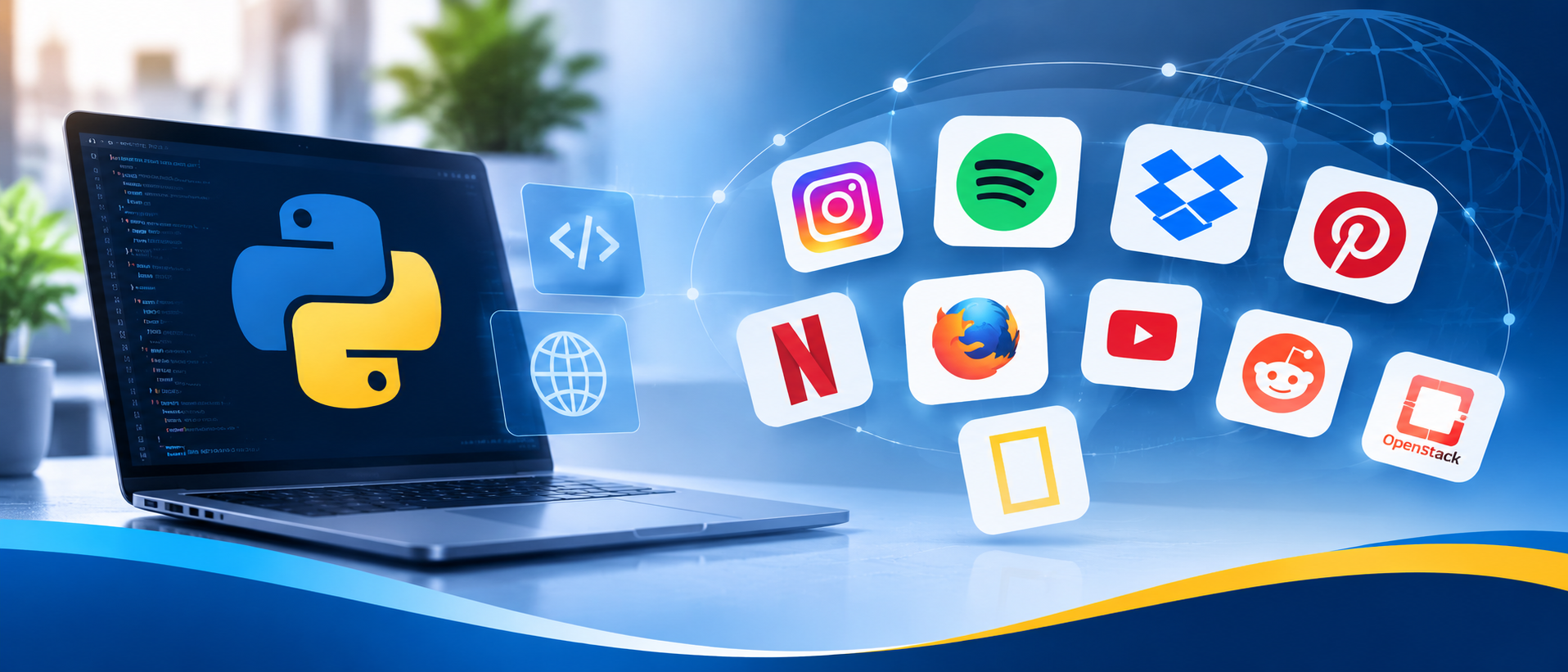
Python has become one of the most widely used programming languages for building modern software applications. Its readable syntax, extensive libraries, flexible frameworks, and strong developer ecosystem make it a practical choice for businesses developing everything from customer-facing websites to complex enterprise platforms.
But Python is not just a language used for small projects or beginner applications. Well-known technology companies use Python in important parts of their software infrastructure, including backend services, data processing, automation, analytics, and web application development.
Some familiar examples include Instagram, Spotify, Dropbox, Pinterest, and Netflix. These platforms demonstrate how Python can support different types of digital products and business requirements.
In this guide, we explore 10 popular websites and digital platforms that use Python, how Python contributes to their technology stacks, what makes each example interesting, and what businesses should consider before choosing Python for their own web development projects.
Whether you are a business owner exploring a new digital product, a developer learning Python, or a technology leader evaluating a backend technology, these examples will help you understand where Python fits into modern web development.
Quick Answer: Which Popular Websites Use Python?
Some well-known websites and platforms that have used Python include:
- Spotify
- Dropbox
- Netflix
- Mozilla
- Disqus
- National Geographic
- OpenStack
- Knight Foundation
Python is used differently across these products. Some have used Django, a Python web framework, for web application development. Others use Python for backend services, data processing, automation, or supporting infrastructure.
Important: These platforms are not necessarily built entirely with Python. Large technology products normally use multiple programming languages, databases, frameworks, and infrastructure tools. The examples below describe documented Python usage rather than suggesting that Python powers every part of each platform.
Why Do Companies Choose Python for Web Development?
Before looking at individual examples, it is useful to understand why businesses choose Python when developing websites and web applications.
Python offers a combination of development speed, flexibility, and a mature ecosystem. It can support an early-stage product as well as complex applications that need integrations, data processing, and ongoing development.
1. Readable and maintainable code
Python is known for its relatively simple and readable syntax. Developers can express application logic without writing as much boilerplate code as some other languages require.
This can make it easier for development teams to understand, test, and maintain an application.
For businesses, maintainability matters because a website or application rarely remains unchanged after launch. New features, integrations, security updates, and performance improvements become part of its ongoing lifecycle.
2. Powerful web development frameworks
Python has several established frameworks that simplify web application development.
The most widely known include:
- Django: A full-featured framework with built-in capabilities for routing, database operations, authentication, administration, and security-related protections.
- Flask: A lightweight framework that gives developers flexibility when building smaller applications, APIs, and custom services.
- FastAPI: A modern framework designed for building APIs using Python type hints, with automatic API documentation support.
The right framework depends on the product's requirements, architecture, team experience, and expected scale.
3. Integration with data science and artificial intelligence
Python has a particularly strong ecosystem for data science, machine learning and artificial intelligence.
Libraries such as NumPy, pandas, scikit-learn, PyTorch and TensorFlow help developers build data-driven features and connect them with web applications.
For example, a business application might use Python to:
- Analyse customer behaviour.
- Generate personalised recommendations.
- Process large datasets.
- Connect to machine learning models.
- Automate repetitive business operations.
- Build AI-powered search and conversational features.
This makes Python useful for products where web functionality and data intelligence need to work together.
4. Flexible database and API integration
Modern web applications rarely operate independently. They connect with payment gateways, CRM systems, ERP platforms, cloud storage, analytics tools, and third-party APIs.
Python supports common databases and integration patterns, making it suitable for applications that need to exchange information with other business systems.
5. A mature developer ecosystem
Python has a large open-source community, extensive documentation, and a broad collection of libraries.
This gives development teams access to established tools for testing, security, deployment, monitoring, and application development.
Businesses can benefit from this ecosystem instead of building every capability from scratch.
10 Popular Websites Built with Python
Let's explore ten examples and understand how Python contributes to their technology ecosystems.
1. Instagram
Industry: Social media and content sharing Python technology: Django
Instagram is one of the most recognisable examples of Python-powered web application development.
The platform supports photo and video sharing, messaging, content discovery, user profiles, and many other interactive features. Its scale creates demanding requirements for application performance, infrastructure efficiency and continuous development.
Instagram uses Python and Django for its backend web infrastructure. Meta has publicly discussed how it uses Python and Django in Instagram's frontend server, along with a multi-process architecture and asynchronous programming techniques.
How Instagram uses Python
Python and Django help support important backend application responsibilities, including:
- Handling application requests.
- Managing business logic and data interactions.
- Supporting user-facing features.
- Connecting application components.
- Supporting development and maintenance workflows.
Instagram also contributes to the Python ecosystem through engineering tools and open-source projects.
For example, Meta's engineering team has discussed its work on Python runtime efficiency and memory management in Instagram's infrastructure.
Why this example matters
Instagram demonstrates that Python and Django can be part of the technology foundation of a large, heavily used consumer application.
However, the important lesson is not that Django alone makes a platform scalable. Large-scale systems also depend on architecture, caching, databases, infrastructure, observability, and engineering practices.
Reference: Meta Engineering – Introducing Immortal Objects for Python
2. Spotify
Industry: Music streaming Python technology: Python backend services and data-processing tools
Spotify is a global music streaming platform that uses technology to deliver music, podcasts, personalised recommendations and other digital experiences.
Python has played an important role in Spotify's engineering ecosystem, particularly in backend services and data analysis.
Spotify's engineering team has explained that Python was used across many backend services and for data-processing workflows.
How Spotify uses Python
Spotify has documented several areas where Python has been useful:
- Backend services that support application functionality.
- Data analysis and processing.
- Recommendation-related data workflows.
- Automated task execution.
- Internal developer tools and services.
Spotify also developed and used Luigi, an open-source Python package for building complex data pipelines.
Data pipelines help teams organise processing tasks, manage dependencies and execute workflows in a structured way.
Why this example matters
Spotify demonstrates that Python is useful beyond traditional website development.
Businesses developing digital products can use Python for backend services, data processing, and intelligent features that support the overall application experience.
It is particularly relevant for platforms that need to combine application development with analytics and data-intensive operations.
Reference: Spotify Engineering – How We Use Python at Spotify
3. Dropbox
Industry: Cloud storage and file collaboration Python technology: Python application and desktop infrastructure
Dropbox is a cloud-based platform that enables users and businesses to store, synchronise, and share files across devices.
Python has been part of Dropbox's technology foundation since its early development.
Dropbox's leadership has publicly discussed how Python helped the company build software that could support multiple operating systems without maintaining entirely separate implementations for each platform.
How Dropbox uses Python
Dropbox has documented Python usage in areas such as:
- Application and desktop client development.
- File synchronisation functionality.
- Cross-platform software development.
- Internal tooling and application maintenance.
- Large-scale code management and type checking.
Dropbox has also published engineering articles about managing millions of lines of Python code and gradually improving code quality through static type checking.
The company has explored other programming languages for performance-critical infrastructure as its systems evolved.
Why this example matters
Dropbox provides an important lesson about choosing a programming language for long-term product development.
Python can help teams build and maintain complex applications, but technology decisions should evolve as performance, infrastructure, and business requirements change.
A successful product does not need to use one programming language for everything.
References:
4. Pinterest
Industry: Visual discovery and social media Python technology: Django
Pinterest is a visual discovery platform where users find, organise and save ideas through images, collections and recommendations.
The platform has used Django, a Python web framework, as part of its server-side web architecture.
Pinterest's engineering team has also documented changes to its web infrastructure, including a move from server-rendered templates towards React for parts of its user experience.
This illustrates how a product's technology stack can evolve while retaining different technologies for different responsibilities.
How Pinterest uses Python
Django has been used to support server-side application functionality.
A web framework such as Django can help development teams manage:
- Application routing and request handling.
- Database interactions.
- User-related application logic.
- Server-side rendering.
- Backend services that support web functionality.
Pinterest's engineering history also shows that frontend and backend technologies can evolve independently.
Why this example matters
Pinterest demonstrates why businesses should think about the complete application architecture rather than selecting a programming language in isolation.
Python can support backend application development while technologies such as React and JavaScript deliver interactive frontend experiences.
This combination can be useful for businesses building content platforms, marketplaces, dashboards and customer-facing web applications.
Reference: Pinterest Engineering – How We Switched Our Template Rendering Engine to React
5. Netflix
Industry: Entertainment and video streaming Python technology: Python across engineering and infrastructure workflows
Netflix is a global entertainment platform that delivers films, television programmes and other content to audiences around the world.
Netflix has publicly described its use of Python across multiple parts of its technology ecosystem.
Its engineering team has explained that Python is used throughout the content lifecycle, from activities related to content decisions to operating infrastructure that delivers video.
How Netflix uses Python
Netflix has described Python usage in several areas, including:
- Data analysis and experimentation.
- Infrastructure management.
- Security automation.
- Content-related workflows.
- Monitoring and operational tools.
- Developer productivity and automation.
The company has also discussed its use of open-source Python packages and contributions to the wider developer ecosystem.
Why this example matters
Netflix demonstrates that Python can be useful in complex digital businesses where application development is only one part of the technology environment.
Python can support operational automation, data processing, and infrastructure tooling alongside other technologies responsible for delivering the core product.
For businesses, this means Python can be considered for more than just the visible website.
Reference: Netflix TechBlog – Python at Netflix
6. Mozilla
Industry: Internet software and browser technology Python technology: Django and Python-based web development
Mozilla is known for products and projects such as Firefox and its broader open-source technology ecosystem.
Mozilla has been included among the organisations associated with Django-powered web applications in Django's ecosystem references and web development documentation.
Python and Django are useful for building web services that require structured application logic, database interactions, and content management.
How Python fits into Mozilla-related web development
Python-based web frameworks can support capabilities such as:
- Dynamic web pages.
- User and account management.
- Content publishing workflows.
- Database-backed services.
- API integrations.
It is important to distinguish Mozilla's web properties and services from the Firefox browser itself. A browser is not simply a Python website; different products and components use different technologies.
Why this example matters
Mozilla illustrates how Python web frameworks can support web applications within a wider technology organisation.
For businesses, this is a reminder that Python can be used for specific services and web properties without being the only programming language across the company.
Reference: MDN – Server-Side Website Programming
7. Disqus
Industry: Online comments and community engagement Python technology: Django
Disqus is a platform that provides commenting and discussion functionality for websites.
Its product helps publishers and website owners add community interaction features without building a complete commenting system from the beginning.
Disqus has been associated with Django, a Python web framework, in Django's examples of websites using the framework.
How Python and Django fit this type of platform
A commenting platform requires more than displaying text beneath an article.
Its backend may need to support:
- User authentication.
- Comment submission and moderation.
- Discussion threads.
- Notifications.
- Data storage and retrieval.
- Integration with external websites.
A framework such as Django provides established components that can help developers implement these application requirements.
Why this example matters
Disqus is a useful example for businesses building community platforms, discussion systems, customer portals, or applications that need user-generated content.
Python can support the backend logic and data management required by these features.
Reference: Django – The Web Framework for Perfectionists with Deadlines
8. National Geographic
Industry: Media and publishing Python technology: Django ecosystem
National Geographic is a well-known media and publishing organisation that produces editorial content, photography, documentaries and educational material.
National Geographic has been included in Django's examples of websites associated with the framework.
Publishing platforms often need to manage large collections of content, media assets, categories, editorial workflows and dynamic pages.
How Python can support publishing platforms
Python-based web applications can help with:
- Content management workflows.
- Database-backed articles and pages.
- Editorial administration.
- Search and content organisation.
- API-based integrations.
- Dynamic website functionality.
Django's built-in administration capabilities and database integration can be particularly useful for applications that manage structured content.
Why this example matters
For media businesses, publishers and organisations managing large content libraries, Python can provide a foundation for building and maintaining content-driven web applications.
The specific architecture still depends on the organisation's publishing systems, frontend requirements, and integrations.
Reference: MDN – Server-Side Website Programming
9. OpenStack
Industry: Cloud computing and infrastructure Python technology: Python-based application and service development
OpenStack is an open-source cloud computing platform used to build and manage cloud infrastructure.
Unlike a conventional consumer website, OpenStack is a collection of interconnected services and software components.
Python has an important role in the OpenStack ecosystem, including the development of its cloud infrastructure services.
How Python is used in OpenStack
Python supports application and service development in areas such as:
- Cloud infrastructure management.
- API-based service communication.
- Resource provisioning.
- Identity and access management.
- Automation and orchestration.
- Infrastructure administration.
This type of architecture requires services to communicate reliably and manage resources through structured APIs.
Why this example matters
OpenStack demonstrates Python's usefulness in complex infrastructure software.
Businesses developing cloud management platforms, internal infrastructure tools and automation systems can consider Python for backend services and API-driven application development.
Reference: OpenStack Documentation
10. Knight Foundation
Industry: Nonprofit and media innovation Python technology: Django ecosystem
The Knight Foundation is a nonprofit organisation that supports journalism, communities, and initiatives related to informed and engaged communities.
It has been included among the organisations associated with Django-powered websites in Django's framework references.
This example is useful because Python and Django are not limited to social media, entertainment, or technology companies. They can also support websites and applications developed for nonprofit and media-related organisations.
How Python can support this type of platform
A content- and programme-oriented website may need:
- Content publishing and administration.
- Searchable information.
- Application and registration workflows.
- Database-backed pages.
- External service integrations.
- Structured content management.
Django provides tools that can help developers implement these capabilities within a maintainable web application.
Why this example matters
The Knight Foundation example highlights Python's flexibility across different organisational needs.
The language can support websites and digital services where content management, structured data, and application workflows are important.
Reference: Django – The Web Framework for Perfectionists with Deadlines
What Do These Python Websites Have in Common?
Although these platforms operate in different industries, their technology requirements share several similarities.
1. They need reliable backend systems
A website is more than its visible interface. Behind every user interaction, there may be application logic, database operations, authentication, APIs, and background processes.
Python frameworks can help developers organise these responsibilities into maintainable application components.
2. They depend on data processing
Modern platforms collect and process large amounts of information.
Examples include:
- User activity.
- Search queries.
- Content interactions.
- Customer preferences.
- Transaction records.
- Application events.
Python's data ecosystem makes it useful for processing and analysing information that supports product functionality.
3. They require integrations
Digital products rarely work as isolated systems.
They connect with databases, cloud platforms, payment services, analytics tools, identity providers, and external APIs.
Python supports these integration requirements through libraries, frameworks, and API development tools.
4. Their technology stacks evolve
A company may begin with one framework and later introduce additional languages, services or infrastructure components.
For example, a Python backend can work alongside a React frontend, a separate data-processing platform, and cloud infrastructure.
The objective should be to select the right technology for each part of the application rather than forcing every component into one language.
Which Python Framework Is Best for Building a Website?
Python offers several frameworks, but Django, Flask, and FastAPI are among the most widely used choices.
The best option depends on the type of application, its complexity, and the way it needs to communicate with other systems.
| Framework | Best suited for | Key characteristics |
|---|---|---|
| Django | Full-featured websites and business applications | Built-in administration, ORM, authentication and structured application components |
| Flask | Lightweight websites and custom applications | Minimal core, flexible architecture and extension ecosystem |
| FastAPI | APIs and backend services | Type hints, automatic API documentation, and asynchronous support |
Django: Best for full-featured web applications
Django is a high-level Python framework designed to help developers build web applications efficiently.
It includes several built-in capabilities, including:
- URL routing.
- Database integration through its ORM.
- Authentication and permissions.
- Administration interface.
- Form handling.
- Security-related protections.
Django can be a suitable choice for content platforms, business portals, marketplaces, and applications that require a structured backend.
Official website: Django
Flask: Best for lightweight and flexible applications
Flask is a lightweight Python web framework.
It provides a smaller core than Django, allowing developers to select the additional libraries and components required by a project.
Flask can be useful for:
- Small and medium-sized web applications.
- REST APIs.
- Internal tools.
- Prototypes and MVPs.
- Custom backend services.
Official documentation: Flask
FastAPI: Best for modern API development
FastAPI is a Python framework designed for building APIs.
It uses Python type hints and supports automatic interactive API documentation.
FastAPI can be a strong option for:
- Backend APIs.
- Microservices.
- AI application backends.
- Data-driven applications.
- Services that need asynchronous request handling.
Official documentation: FastAPI
Is Python a Good Choice for Building Business Websites?
Python can be an excellent choice for business websites and web applications, but the right decision depends on the project's requirements.
For a simple informational website, a traditional content management system may be more practical than developing a custom Python application.
However, Python becomes particularly useful when a business needs custom functionality, complex workflows, integrations, or data-driven features.
When Python is a good choice
Consider Python when you are building:
- Custom business web applications.
- Customer and employee portals.
- SaaS platforms.
- Data-driven dashboards.
- Marketplace applications.
- AI-powered web applications.
- API-based business systems.
- Workflow automation platforms.
When another technology may be more suitable
Python is not automatically the best choice for every project.
Another technology or architecture may be more appropriate when:
- The application has highly specialised real-time performance requirements.
- The development team has strong expertise in another ecosystem.
- The project needs a particular platform or framework integration.
- The website is mostly static and does not need a custom backend.
- The existing application architecture makes a different technology more practical.
The best technology decision should consider performance, maintainability, security, development cost, integration requirements, and long-term product goals.
What Should Businesses Consider Before Building a Python Website?
Choosing Python is only one part of the development process. Businesses should also consider the architecture, security, scalability, and ongoing maintenance of the application.
Here are some important factors to evaluate.
1. Understand business and user requirements
Start by identifying what the application needs to accomplish.
Consider:
- Who will use the application?
- What problems will it solve?
- What features are essential for the first release?
- Which external systems need to be integrated?
- What are the expected user and data requirements?
A clear requirement definition helps prevent unnecessary development and technology decisions.
2. Choose the right framework and architecture
Select Django, Flask, FastAPI, or another technology based on the application's needs.
Also consider whether the application should use a modular monolith, a service-oriented architecture or microservices.
Microservices should not be introduced automatically. They add operational complexity and are most useful when the product's scale, team structure, and independent deployment needs justify them.
3. Plan database and API integrations
Determine how the application will store, retrieve, and exchange information.
Common considerations include:
- PostgreSQL or other suitable databases.
- API authentication and access controls.
- Data validation.
- Integration error handling.
- Background jobs.
- Database backups and recovery.
4. Prioritise application security
Security should be part of the development process from the beginning.
Important areas include:
- Authentication and authorisation.
- Secure session management.
- Input validation.
- Protection against common web vulnerabilities.
- Secure handling of credentials and secrets.
- Dependency updates.
- Logging and monitoring.
Django provides built-in protections for several common security concerns, but developers must configure and use them correctly.
5. Design for performance and future growth
A growing application may need caching, database optimisation, background processing, load balancing, and infrastructure improvements.
The architecture should be designed around realistic usage patterns and measured performance requirements.
Python itself does not guarantee scalability. Good system design and ongoing performance testing are essential.
6. Plan maintenance and continuous improvement
Launching the website is not the end of development.
Businesses should plan for:
- Bug fixes and security updates.
- Framework and dependency upgrades.
- Performance monitoring.
- Feature improvements.
- Automated testing.
- Documentation.
- Cloud and deployment management.
A maintainable application is easier to improve as business requirements change.
Final Thoughts
Python has become an important technology in modern web development because it combines readable code, mature frameworks, strong integration capabilities, and a broad ecosystem for data and artificial intelligence.
Examples such as Instagram, Spotify, Dropbox, Pinterest and Netflix show how Python can support different parts of large digital products. Other organisations associated with Django demonstrate its use in publishing, community platforms and web services.
However, successful products are not built through programming language selection alone. Their performance and long-term reliability depend on application architecture, engineering practices, infrastructure, security and continuous improvement.
For businesses planning a new web application, SaaS product, or custom digital platform, Python is worth considering when its ecosystem and capabilities align with the product's requirements.
If you are planning to build a custom business application, the most useful first step is to define the product requirements, integration needs, and technical architecture before selecting the development stack.
At Spectrum Future Tech, we work on custom software development and digital product engineering, helping businesses plan and build web applications, enterprise platforms, and integrated software solutions.
Explore our Custom Software Development Services to understand how we approach custom application development, from technical planning to production delivery.
You can also learn more about How We Deliver and our approach to building and shipping software.
Frequently Asked Questions (FAQs)
1. Which popular websites are built using Python?
Popular websites and platforms associated with Python include Instagram, Spotify, Dropbox, Pinterest, Netflix, Mozilla, Disqus, National Geographic, OpenStack, and Knight Foundation. Python is used in different parts of their technology stacks, rather than necessarily powering every component.
2. Is Instagram built with Python?
Instagram uses Python and Django for its backend web infrastructure. Meta has publicly discussed its use of Python and Django in Instagram's frontend server, along with engineering techniques for managing performance and memory at scale.
3. Does Spotify use Python?
Yes. Spotify has documented the use of Python in backend services, data analysis, and data-processing workflows. It has also developed Python tools such as Luigi for managing data pipelines.
4. Is Python good for building large websites?
Python can support large web applications when it is combined with suitable architecture, infrastructure, database design, caching, monitoring, and engineering practices. Scalability depends on the complete system, not just the programming language.
5. Which Python framework is best for web development?
Django is a good choice for full-featured web applications, Flask is useful for lightweight and flexible projects, and FastAPI is designed for modern API development. The best framework depends on the project's requirements.
6. Can Python be used for both frontend and backend development?
Python is primarily used for backend development rather than browser-based frontend interfaces. Developers commonly combine Python frameworks with frontend technologies such as HTML, CSS, JavaScript, React or Vue.js.
7. Is Django better than Flask?
Neither framework is universally better. Django provides more built-in functionality and structure, while Flask offers a lightweight core and more flexibility in selecting components. The right choice depends on the application.
8. Can Python be used to build SaaS applications?
Yes. Python frameworks such as Django and FastAPI can support SaaS application backends, APIs, authentication, database operations, and integrations. A complete SaaS product also needs frontend development, infrastructure, security, billing, and operational planning.
9. Is Python suitable for AI-powered websites?
Yes. Python has a strong ecosystem for machine learning, data processing, and AI development. It can be used to build application backends that connect with AI models, retrieval systems, recommendation engines, and other intelligent features.
10. How much does it cost to build a Python website?
The cost depends on the website's functionality, design, integrations, security requirements, infrastructure, and development scope. A simple website and a complex enterprise application require very different levels of engineering effort. A detailed project assessment is needed before estimating the cost.
11. Can an existing website be migrated to Python?
Yes, an existing website can be migrated or rebuilt using Python, depending on its current architecture, business requirements, and integrations. A migration plan should consider data transfer, API compatibility, security, testing, and downtime.
12. Why should a business choose custom Python web development?
Custom Python web development can be useful when a business needs tailored workflows, complex integrations, data-driven features or a product that cannot be delivered effectively through a standard website platform. The decision should be based on the product's requirements and long-term goals.