

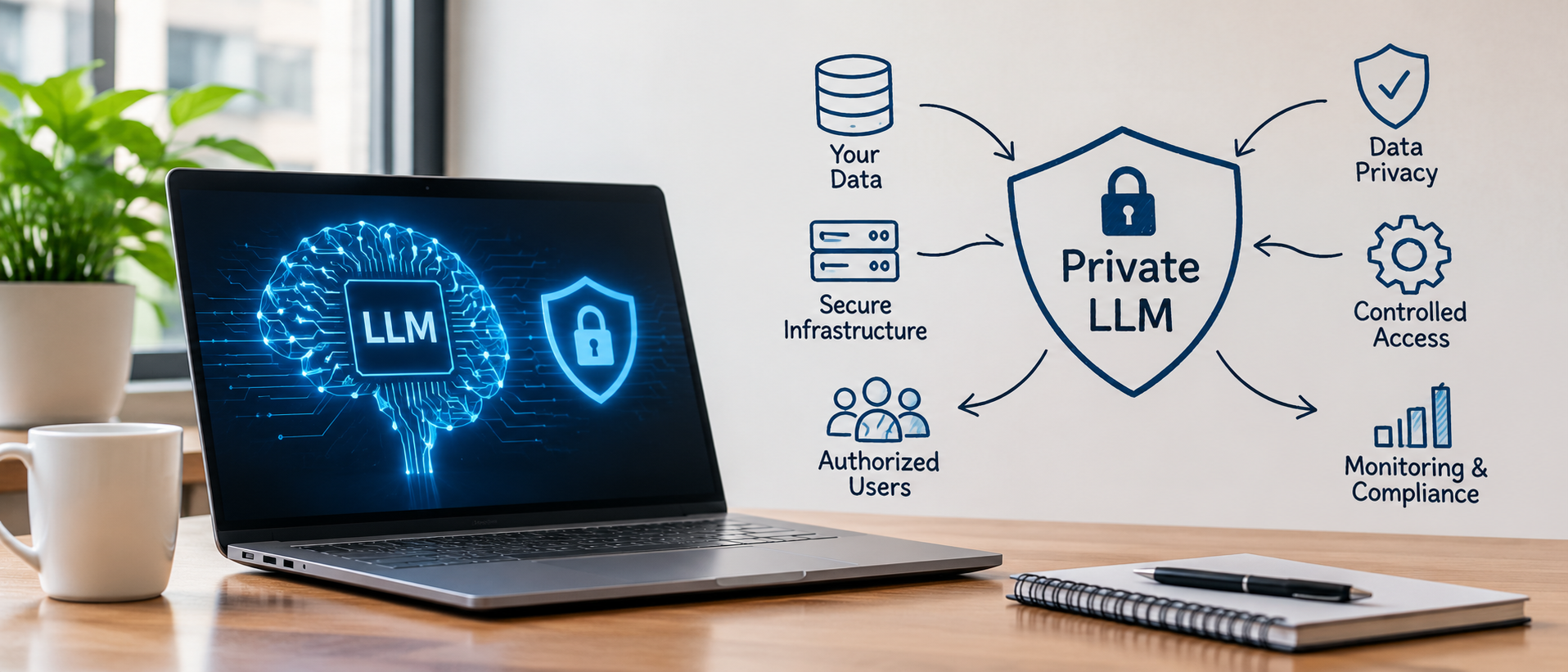
Private LLM for Enterprises: Benefits, Architecture, Deployment, and Security Guide
Businesses are increasingly exploring generative AI to improve productivity, automate repetitive work, analyse information, and make better use of their internal knowledge. However, adopting AI also introduces an important concern: what happens to confidential business information when employees use an AI tool?
Contracts, customer records, financial reports, employee information, product documentation, source code, and internal business strategies may contain information that organisations cannot casually share with external platforms.
This is one reason why interest in a Private LLM for Enterprises is growing.
A private Large Language Model (LLM) gives organisations greater control over how AI models are hosted, how business information is processed, who can access the system, and where prompts and generated responses are stored. Depending on the architecture, a private LLM can operate within an organisation's own data centre, a dedicated cloud environment, or a controlled hybrid infrastructure.
However, deploying a private LLM involves more than downloading an open-weight model and running it on a server. Businesses must consider model selection, infrastructure, data integration, retrieval systems, access management, security, performance, and ongoing maintenance.
This guide explains how private LLMs work, why enterprises are adopting them, which deployment architecture makes sense, how to implement them, and what organisations should evaluate before investing in private AI infrastructure.
What Is a Private LLM for Enterprises?
A Private LLM for Enterprises is a large language model deployed through an infrastructure and operating arrangement that gives an organisation control over how the model processes information and how its associated data is handled.
Unlike a typical public AI chatbot, where users interact with a service hosted by an external provider, a private LLM can be deployed within an organisation's own infrastructure or a dedicated cloud environment.
For example, imagine a financial services company that wants employees to ask questions about internal policies, customer documentation, and financial procedures.
Using a public AI tool may introduce data-handling concerns. The organisation may instead deploy a private LLM connected to an internal knowledge base. Employees can then ask questions and receive responses based on authorised company documents.
The organisation can define:
- Where the model is hosted.
- Which employees can access it.
- Which documents the model can retrieve.
- Whether information can leave the approved network.
- How prompts and responses are logged.
- How long application data is retained.
- Which external services or integrations are permitted.
The exact level of control depends on the deployment architecture and configuration.
Private LLM vs. Self-Hosted LLM vs. On-Premises LLM
These terms are related, but they do not always mean the same thing.
Private LLM describes an arrangement in which the organisation controls the model's data-processing environment and associated access policies.
Self-hosted LLM generally means that the organisation operates the model-serving infrastructure itself, either on its own hardware or within infrastructure it manages.
On-premises LLM refers specifically to a deployment running on servers located within the organisation's own physical facilities.
A private LLM can be self-hosted or delivered through a suitably configured dedicated cloud environment. An on-premises deployment is one way of achieving private AI, but it is not the only option.
This distinction matters because businesses should select an architecture based on their data governance, operational requirements, and technical capabilities rather than assuming that every private LLM must run inside their office or data centre.
Why Are Enterprises Investing in Private LLM Solutions?
The business case for private AI is not limited to keeping confidential information away from public tools. Organisations also want greater control over AI workflows, internal knowledge, application integrations, and long-term technology decisions.
Here are the main reasons businesses consider private LLM deployment.
1. Greater Control Over Sensitive Business Data
Many organisations handle information that should only be available to authorised employees and systems.
Examples include:
- Customer information and financial records.
- Employee and HR documentation.
- Contracts and legal agreements.
- Intellectual property and product designs.
- Internal source code and technical documentation.
- Business strategies and commercial proposals.
A private deployment can keep prompts, retrieved documents, and generated responses within approved infrastructure boundaries.
However, hosting the model privately is only one part of the solution. External APIs, telemetry, backups, monitoring services, application logs, and integrations must also be reviewed to establish where information travels.
2. Better Control Over Access and Permissions
Not every employee should have access to every company document.
For example, an HR employee may need information about recruitment policies, while a finance employee may need access to financial procedures. Neither should automatically receive access to confidential information belonging to another department.
A private enterprise AI solution can integrate with identity providers and role-based access controls to apply permissions to users and their data.
This is particularly important when an LLM is connected to a large internal knowledge base.
3. More Flexible AI Integration
Businesses rarely operate through a single software platform.
They may use CRM applications, ERP systems, helpdesk platforms, databases, document management tools, and custom enterprise applications.
A private LLM can be integrated with these systems through APIs and controlled application workflows.
For example, an internal AI assistant could retrieve customer information from a CRM, summarise support history, and prepare a response for an employee.
The AI model provides language understanding and generation, while the backend application controls data access and business operations.
4. Greater Control Over Model Selection
Different business applications require different model capabilities.
A company may need a smaller model for document classification, a stronger model for complex reasoning, and a specialised model for multilingual communication.
Private LLM infrastructure allows technical teams to evaluate compatible open-weight models and select them based on:
- Accuracy on business-specific tasks.
- Language support.
- Response speed.
- Hardware requirements.
- Context window.
- Tool-calling capabilities.
- Licensing and commercial-use conditions.
This flexibility can reduce dependence on a single model provider.
5. Data Residency and Governance Requirements
Some organisations operate under contractual, regulatory, or internal policies that restrict where information can be processed or stored.
A private AI architecture can help organisations implement data residency and access requirements by controlling infrastructure locations, network connections, storage, and data flows.
However, private deployment does not automatically establish compliance with GDPR, HIPAA, or other regulatory frameworks. Compliance depends on the complete processing arrangement, applicable legal obligations, security controls, documentation, and organisational practices.
6. Greater Control Over AI Infrastructure and Availability
A self-hosted model can give an organisation more control over model versions, serving capacity, release schedules, and infrastructure configuration.
This can be valuable when an AI application supports important business workflows.
The trade-off is operational responsibility. The organisation must manage capacity, infrastructure failures, updates, backups, monitoring, and recovery.
Private LLM Deployment Options: Which Architecture Should Enterprises Choose?
There is no single deployment model that works for every organisation.
The right choice depends on data sensitivity, infrastructure availability, performance requirements, budget, internal expertise, and the level of isolation required.
The four common approaches are public AI APIs, private cloud deployment, on-premises hosting, and air-gapped deployment. Each option offers a different balance of flexibility, security, infrastructure control, and operational complexity.
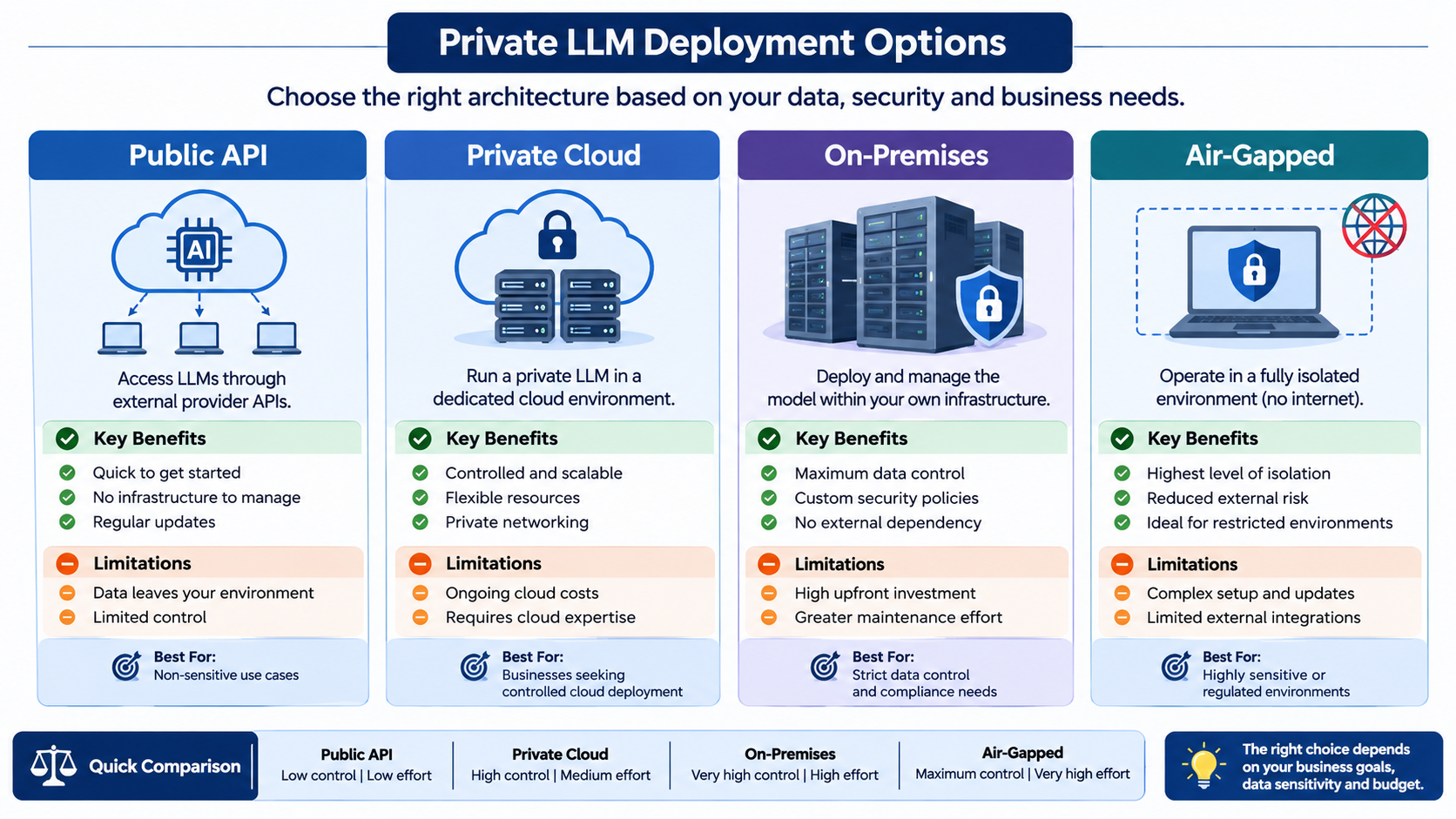
The comparison above provides an overview of how these deployment models differ. Let's examine each approach, including its advantages, limitations, and the situations in which it makes the most sense for an enterprise.
1. Public AI API
With a public AI API, an application sends requests to a model hosted by an external provider.
The provider manages the underlying model infrastructure, while the organisation integrates the API into its applications.
Advantages:
- Faster implementation.
- No need to operate GPU infrastructure.
- Access to managed model updates.
- Easier scaling for variable workloads.
- Lower initial infrastructure investment.
Limitations:
- Data is processed by an external service.
- Data handling depends on provider terms and configuration.
- Organisations have less control over underlying infrastructure.
- Usage-based charges can increase with demand.
- Some data residency or isolation requirements may not be satisfied.
An enterprise API with suitable contractual protections and privacy controls may be appropriate for many business workloads. It should not automatically be treated as equivalent to self-hosting.
2. Private Cloud LLM Deployment
A private cloud LLM runs within a dedicated or isolated cloud environment.
The organisation may deploy model-serving infrastructure inside its own cloud account or a controlled virtual private cloud.
The cloud provider supplies computing infrastructure, while the organisation manages or controls the model deployment and related services.
Advantages:
- Greater infrastructure control than a typical shared public endpoint.
- Flexible GPU capacity.
- Easier integration with cloud-hosted business applications.
- Options for private networking and identity management.
- Less physical infrastructure to maintain.
Limitations:
- Ongoing cloud infrastructure costs.
- Requires cloud security expertise.
- Network and access configurations must be carefully managed.
- Data may still pass through external cloud services depending on the architecture.
Private cloud is often a practical starting point for businesses that want more control without purchasing and maintaining their own GPU servers.
3. On-Premises LLM Deployment
An on-premises LLM runs on infrastructure owned or operated within an organisation's data centre or server facilities.
The organisation controls the physical hardware, network environment, model-serving infrastructure, and storage configuration.
Advantages:
- Strong control over physical infrastructure.
- Greater flexibility over network isolation.
- Direct control over data storage and retention.
- Suitable for organisations with existing data centres.
- Can support strict internal infrastructure policies.
Limitations:
- Higher upfront infrastructure requirements.
- Hardware procurement and maintenance.
- Power and cooling requirements.
- Need for specialised engineering expertise.
- Capacity planning and hardware upgrades remain the organisation's responsibility.
On-premises deployment may be suitable for organisations with established infrastructure teams and specific data-control requirements.
4. Air-Gapped LLM Deployment
An air-gapped LLM operates in an environment that is physically or logically isolated from external networks, including the public internet.
This approach is considered when organisations have exceptionally strict security or operational requirements.
For example, a restricted government environment may require the model, document repositories, inference services, and supporting components to operate without external network connectivity.
Advantages:
- Very high control over external network communication.
- Suitable for restricted operational environments.
- Reduced exposure to direct internet-based attacks.
- Can support specific data sovereignty requirements.
Limitations:
- Complex installation and maintenance.
- Updates and security patches require controlled transfer procedures.
- External integrations are restricted.
- Monitoring and troubleshooting become more difficult.
- Hardware and operational costs can be substantial.
An air-gapped deployment should be selected only when the organisation's risk assessment or operating requirements justify the additional complexity.
Private LLM Deployment Comparison
| Deployment model | Infrastructure control | Initial investment | Operational complexity | Suitable for |
|---|---|---|---|---|
| Public AI API | Limited | Low | Low | Prototypes and suitable non-sensitive workloads |
| Private cloud | High, depending on configuration | Low to medium | Medium | Businesses seeking controlled cloud deployment |
| On-premises | Very high | High | High | Organisations with strict infrastructure requirements |
| Air-gapped | Very high | Very high | Very high | Restricted and highly isolated environments |
The important decision is not simply which deployment offers the highest privacy. It is which architecture provides the right balance between data control, performance, cost, availability, and operational responsibility.
Private LLM Architecture: How Does an Enterprise AI System Work?
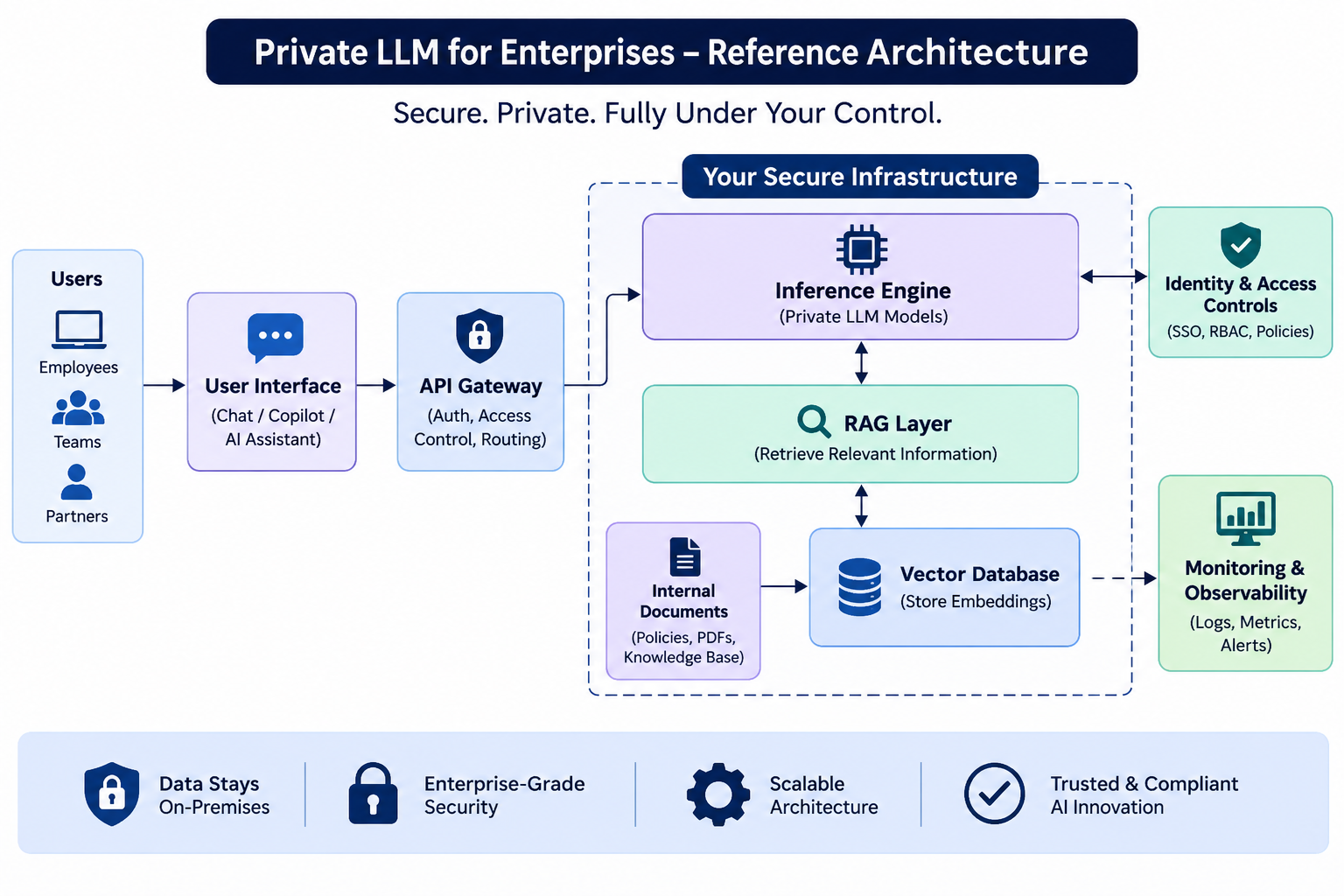
A production-ready private LLM is made up of several connected components.
The model itself is only one part of the architecture. A complete solution also needs an application interface, backend services, model-serving infrastructure, knowledge retrieval, identity management, security controls, and monitoring.
A typical enterprise private LLM architecture can be understood through the following layers.
1. User Interface Layer
This is where employees or authorised customers interact with the AI application.
The interface may be:
- An internal enterprise chatbot.
- A web-based AI assistant.
- A mobile application.
- A customer support portal.
- An AI-enabled dashboard.
- An integrated assistant within existing business software.
The interface should authenticate users and communicate with the backend through secure application endpoints.
2. Application and API Layer
The backend receives user requests and manages the application's business logic.
Its responsibilities may include:
- User authentication.
- Session and conversation management.
- Request validation.
- Permission checks.
- API integration.
- Workflow execution.
- Response formatting.
- Error handling.
The backend should not rely on the language model alone to make security decisions.
For example, if an employee asks for confidential financial information, the application must verify the employee's permissions before retrieving the information and sending it to the model.
3. AI Gateway and Orchestration Layer
An AI gateway provides a controlled entry point between applications and model-serving infrastructure.
It can manage:
- Authentication and API keys.
- Request routing.
- Model selection.
- Rate limits.
- Usage policies.
- Request validation.
- Monitoring.
- Provider or model switching.
The orchestration layer coordinates the model with other components, including RAG pipelines, business APIs, and AI agents.
Separating this layer from the inference engine also makes it easier to change models or serving technologies without redesigning the entire application.
4. LLM Inference Layer
This layer runs the selected language model and processes incoming requests.
Depending on the architecture, enterprises may use inference engines such as:
- vLLM: Designed for efficient, high-throughput LLM serving.
- Hugging Face Text Generation Inference (TGI): A model-serving solution with support for production inference workloads.
- llama.cpp: A lightweight inference framework that supports local model execution across supported hardware.
- Ollama: A tool that simplifies running and managing supported models locally.
- NVIDIA NIM: A collection of optimised inference microservices for supported AI models and infrastructure.
The appropriate technology depends on the model, hardware, concurrency, performance expectations, and operational requirements.
For example, an organisation building a high-traffic internal AI platform may evaluate vLLM for its serving capabilities.
Read our guide on what vLLM is and how businesses can build scalable AI applications.
5. Enterprise Knowledge and Data Layer
Many private AI applications need access to company-specific information.
This layer may include:
- Internal document repositories.
- Relational databases.
- Enterprise content management systems.
- Vector databases.
- Product documentation.
- CRM and ERP data.
- Knowledge management platforms.
The AI system retrieves relevant information from these sources and supplies authorised context to the language model.
Retrieval-Augmented Generation is commonly used to achieve this.
6. Security and Identity Layer
The security layer applies controls across the entire application.
It may include:
- Single sign-on (SSO).
- Role-based access control (RBAC).
- Multi-factor authentication.
- Encryption.
- Network segmentation.
- Secrets management.
- Audit logging.
- Data retention policies.
- Administrative access restrictions.
Security should be built into the architecture rather than added after the AI application is completed.
7. Monitoring and Operations Layer
Once deployed, the system needs continuous monitoring.
Organisations should measure:
- Response latency.
- Throughput.
- GPU utilisation.
- Error rates.
- Model availability.
- Retrieval accuracy.
- Token consumption.
- User feedback.
- Security events.
- Infrastructure capacity.
This helps technical teams identify performance issues, improve model quality, and maintain service reliability.
How to Choose the Right Private LLM Model for Your Business
Selecting the right language model is one of the most important decisions in a private AI project.
A larger model is not automatically the best choice. The right model is the one that delivers acceptable results for the organisation's actual tasks within its available infrastructure and operating constraints.
1. Identify the Business Use Case First
Start by understanding what the model needs to accomplish.
For example:
- Document summarisation.
- Internal knowledge search.
- Customer support.
- Contract information extraction.
- Technical documentation assistance.
- Multilingual communication.
- Code assistance.
- Business report generation.
A model that performs well at summarising documents may not necessarily be the best choice for complex reasoning or tool-based workflows.
2. Evaluate Model Size and Performance
Models are often described by their parameter counts, such as 7B, 14B, or 70B.
Parameter count can influence memory requirements and model capability, but it should not be treated as a direct measure of quality.
Smaller models may be sufficient for classification, extraction, and straightforward internal assistance.
Larger models may be more suitable for demanding reasoning tasks, but they generally require more computing resources.
Evaluate models against representative business prompts instead of selecting them based on size alone.
3. Review Popular Open-Weight Model Families
Several model families are commonly evaluated for private LLM projects.
Llama: Meta's model family includes multiple model sizes and capabilities that can be evaluated for different enterprise applications.
Mistral: Offers models designed for different performance and deployment requirements.
Qwen: Provides a range of models with capabilities relevant to multilingual applications, coding, and general-purpose tasks.
Gemma: Google's open-weight model family includes models for different development and deployment scenarios.
DeepSeek: Includes model families designed for general-purpose and reasoning-oriented applications.
These are examples rather than a permanent ranking. Model capabilities, availability, licences, and hardware compatibility change over time.
4. Check Licensing Before Commercial Deployment
An open-weight model is not automatically unrestricted for commercial use.
Before selecting a model, review:
- The exact model version.
- The licence attached to that release.
- Commercial-use permissions.
- Redistribution requirements.
- Attribution obligations.
- Acceptable-use conditions.
- Any additional restrictions.
The model's code, weights, training data, and documentation may have different licensing arrangements.
Businesses should obtain legal review where licensing or intellectual property obligations are material.
5. Test Language and Domain Capabilities
A model that performs well in general English conversations may not perform equally well with technical documentation, industry terminology, or regional languages.
For example, a multinational organisation may need its internal assistant to understand English, Arabic, Hindi, and other languages used by its employees.
Create a representative test set containing real business scenarios and evaluate each model for accuracy, clarity, consistency, and task completion.
What Hardware and Infrastructure Are Required to Run a Private LLM?
The hardware requirements depend on the model architecture, model size, numerical precision, context length, number of simultaneous users, and performance expectations.
GPU memory is one of the most important considerations because the system needs to load model weights and maintain additional memory for inference.
1. GPU Memory and Model Size
A model's parameter count gives a starting point for estimating memory requirements.
For example, a model with 7 billion parameters stored at 16-bit precision requires approximately 14 GB for its raw weights alone.
A model with 70 billion parameters at the same precision requires approximately 140 GB for raw weights.
These are simplified weight-storage estimates, not complete server specifications.
Actual requirements are higher because inference also needs memory for:
- KV cache.
- Context length.
- Concurrent requests.
- Runtime overhead.
- Temporary processing operations.
The required memory can change significantly with quantisation and deployment configuration.
2. GPU Selection
GPU selection should consider more than model compatibility.
Evaluate:
- Available GPU memory.
- Memory bandwidth.
- Supported precision formats.
- Inter-GPU communication.
- Inference engine compatibility.
- Expected request volume.
- Hardware availability.
- Support and maintenance requirements.
A smaller model may run on a single compatible GPU, while larger models or high-concurrency workloads may require multiple GPUs.
3. CPU, RAM, and Storage
A private LLM server also requires sufficient CPU resources, system memory, and fast storage.
CPUs handle application services, data preparation, request processing, and other supporting workloads.
System RAM supports the operating system, data pipelines, vector databases, and application processes.
Fast NVMe storage can improve model loading and document-processing operations.
4. Networking and Scalability
Networking becomes important when the system runs across multiple servers or integrates with enterprise applications.
Consider:
- Network throughput.
- Latency between services.
- Private connectivity.
- Secure API communication.
- Load balancing.
- Redundant network paths.
- Network segmentation.
The architecture should also allow additional inference capacity to be introduced when demand increases.
5. Supporting Software Infrastructure
A production environment may require:
- Operating system and GPU drivers.
- Containerisation.
- Model-serving software.
- API gateway.
- Application backend.
- Vector database.
- Identity provider.
- Monitoring tools.
- Deployment automation.
- Backup and recovery processes.
The complete infrastructure should be designed around the expected business workload rather than choosing hardware first and trying to fit the application around it.
How RAG Makes Private LLMs More Useful for Enterprises
A general-purpose language model does not automatically know an organisation's latest internal information.
It may not know the company's current pricing policy, employee handbook, product documentation, customer procedures, or internal operating guidelines.
Retrieval-Augmented Generation (RAG) helps solve this problem by connecting a language model to an external knowledge source.
Instead of relying only on information learned during training, the system retrieves relevant information from authorised company data and provides it as context for the response.
What Is Retrieval-Augmented Generation?
RAG is an architecture that combines information retrieval with language generation.
A user asks a question. The application searches an approved knowledge source for relevant information, retrieves suitable content, and passes that content to the language model.
The model then uses the retrieved context to generate an answer.
For example, an employee asks:
"What is our current leave policy for employees working remotely?"
The RAG system searches the authorised HR knowledge base, retrieves the relevant policy sections, and supplies them to the private LLM.
The model generates a response based on the retrieved information.
How Does Enterprise RAG Work?
A typical private RAG workflow includes these stages:
Step 1: Collect Business Documents
The system connects to approved document repositories, internal knowledge platforms, databases, and other business information sources.
Step 2: Extract and Prepare Information
Documents are processed to extract text and useful metadata.
The preparation process may include removing duplicate content, handling outdated files, identifying document owners, and classifying information by sensitivity.
Step 3: Divide Documents into Chunks
Large documents are divided into smaller sections so that the retrieval system can locate relevant information efficiently.
Chunk size and overlap should be tested against the document types and retrieval requirements.
Step 4: Generate Embeddings
An embedding model converts text into numerical representations that can be used for semantic search.
The embedding model should be selected and deployed in accordance with the organisation's data-processing requirements.
Step 5: Store Information in a Vector Database
The generated embeddings and associated metadata are stored in a vector database or another suitable retrieval index.
The database may also store document identifiers, access labels, timestamps, and source references.
Step 6: Retrieve Relevant Information
When an employee submits a question, the system searches for relevant document sections.
The retrieval process should enforce user permissions before information is provided to the model.
Step 7: Generate the Response
The retrieved context is passed to the private LLM, which generates an answer using the available information.
Step 8: Return Sources and References
Where possible, the application should show the documents or sections used to generate the response.
This helps employees verify information instead of relying blindly on generated answers.
Why Permission-Aware RAG Is Important
One of the most serious risks in enterprise AI is allowing a user to retrieve information they are not authorised to access.
Imagine that the company knowledge base contains both general HR policies and confidential executive compensation records.
An employee asking about leave policies should not receive information from restricted compensation documents.
A secure RAG system must enforce document-level or equivalent access permissions during retrieval. It should not assume that because a document is indexed, every employee can access it.
RAG can make private LLM applications more relevant and useful, but it does not eliminate hallucinations or guarantee factual accuracy. Retrieval quality, document quality, model behaviour, and validation all matter.
Private LLM Security: How Enterprises Can Protect AI Workloads
Deploying a language model inside private infrastructure does not automatically make the entire AI application secure.
An organisation may control where the model runs while still exposing sensitive information through weak authentication, poorly configured APIs, insecure document retrieval, excessive permissions, or application logs.
Security must cover the complete AI system.
1. Role-Based Access Control
Role-based access control assigns permissions based on the responsibilities of each user.
For example:
- HR employees may access approved HR knowledge.
- Finance employees may access authorised financial documentation.
- IT administrators may manage infrastructure.
- Auditors may access relevant activity records.
- General employees may access approved internal information.
The application should verify permissions before retrieving documents or executing actions.
2. Single Sign-On and Multi-Factor Authentication
Integrating the AI application with the organisation's identity provider can simplify access management.
Single sign-on allows employees to use approved organisational credentials.
Multi-factor authentication provides an additional verification layer.
When employees change roles or leave the organisation, access permissions should be updated through the identity management process.
3. Encryption at Rest and in Transit
Encryption helps protect information stored and transmitted by the AI application.
Consider encryption for:
- Model-related storage where appropriate.
- Business documents.
- Vector database storage.
- Application databases.
- Backups.
- API communication.
- Internal service connections.
TLS should be used for secure communication between application components where supported.
Encryption keys should be managed through an appropriate secrets or key-management system.
4. Network Segmentation and Private Connectivity
Not every AI component needs unrestricted network access.
Separate application services, model-serving infrastructure, databases, and administrative systems into appropriate network zones.
Apply firewall rules and private connectivity controls to restrict communication to approved services.
If the organisation requires that prompts and documents never leave its network, the complete data flow must be assessed, including external telemetry, monitoring, package repositories, and integrations.
5. Prompt Injection Protection
Prompt injection is a security risk in which malicious instructions are introduced through user inputs or retrieved content to influence the model's behaviour.
For example, a malicious document could contain instructions designed to make an AI assistant reveal confidential information or misuse connected tools.
Possible safeguards include:
- Treating retrieved documents as untrusted content.
- Separating instructions from retrieved information.
- Limiting the permissions of connected tools.
- Validating tool requests.
- Restricting access to sensitive information.
- Requiring approval for high-impact actions.
- Testing the system with adversarial prompts.
No single prompt instruction can reliably prevent every prompt injection attack. Security must be enforced through application and infrastructure controls.
6. Secure AI Agent Permissions
When a private LLM is connected to AI agents, the system may be able to interact with business applications and perform actions.
For example, an AI assistant may retrieve CRM records, create support tickets, or prepare purchase requests.
These capabilities introduce additional risk if agents have excessive permissions.
Organisations should:
- Give each agent only the permissions it needs.
- Separate read and write operations.
- Validate actions before execution.
- Require human approval for sensitive transactions.
- Record tool calls and outcomes.
- Apply limits to repeated or unexpected actions.
A model should not be given unrestricted access to business systems simply because it is running privately.
7. Audit Logging and Monitoring
Audit logging helps organisations investigate how the AI system is being used.
Useful audit information may include:
- User identity.
- Time of access.
- Model version.
- Retrieved document identifiers.
- Tool calls.
- Administrative changes.
- Security events.
- Application errors.
Logging full prompt and response content requires additional care because logs themselves may contain confidential information.
Organisations should define what is recorded, who can access logs, and how long they are retained.
8. Protect the Model Supply Chain
Private AI deployments depend on more than the model itself.
They may use model weights, container images, libraries, embedding models, datasets, inference engines, and third-party dependencies.
Each component should be reviewed before it enters the production environment.
Use trusted sources, verify model and software artefacts where possible, scan dependencies, and maintain a controlled update process.
For a broader view of LLM-specific threats, organisations can refer to the OWASP Top 10 for Large Language Model Applications.
Private LLM vs. Fine-Tuning vs. RAG: What Is the Difference?
These three concepts are sometimes treated as interchangeable, but they solve different problems.
Private LLM deployment describes where and how a language model is operated.
Fine-tuning modifies a model's learned parameters using additional training data to adapt its behaviour for a particular task or domain.
RAG retrieves relevant information from external knowledge sources and supplies it to the model during a request.
A private LLM can use RAG, fine-tuning, or both.
When Should Businesses Use RAG?
RAG is often a suitable starting point when an organisation wants an LLM to answer questions using internal documents that change regularly.
Examples include:
- Company policies.
- Product documentation.
- Technical manuals.
- Internal knowledge bases.
- Customer support information.
- Operational procedures.
The organisation can update its document index without retraining the underlying language model.
When Should Businesses Consider Fine-Tuning?
Fine-tuning may be useful when a model needs to learn a more consistent output style, specialised task behaviour, or domain-specific response patterns.
Potential applications include:
- Structured information extraction.
- Consistent classification.
- Domain-specific language generation.
- Specialised response formatting.
- Task-specific model adaptation.
Fine-tuning should not be treated as the default way to add frequently changing company information to a model.
Can Enterprises Combine RAG and Fine-Tuning?
Yes.
For example, a legal technology platform may use fine-tuning to improve how the model structures contract analysis while using RAG to retrieve current client documents and approved legal templates.
The two techniques can complement each other when there is a clear requirement for both.
Practical Enterprise Use Cases for Private LLM Solutions
Private LLMs can support a range of business applications, particularly when organisations want to use internal knowledge and automate information-heavy processes.
1. Internal Enterprise AI Assistant
An internal AI assistant can help employees find information from company documents, policies, procedures, and knowledge bases.
For example, an employee could ask:
"Which approval process should I follow before purchasing new software?"
The assistant can retrieve the relevant internal procedure and provide an answer with source references.
This can reduce time spent searching through documents and asking colleagues for routine information.
2. Private AI for Financial Services
Financial organisations handle confidential customer records, transaction information, compliance documents, and internal reports.
A private AI system can assist authorised employees with:
- Financial document summarisation.
- Policy searches.
- Report preparation.
- Information extraction.
- Internal knowledge retrieval.
Any system handling regulated financial information should be designed with appropriate access controls, validation, and compliance review.
3. Healthcare Knowledge and Administrative Support
Healthcare organisations manage patient documentation, medical research, operational policies, and administrative records.
A private AI assistant may support authorised staff with document search, administrative summaries, and internal knowledge retrieval.
It should not be treated as an independent replacement for qualified clinical judgement. Patient information also requires appropriate safeguards and regulatory review.
4. Legal Document Analysis
Legal teams work with large volumes of contracts, agreements, case documents, and regulatory information.
A private LLM connected to a permission-controlled document repository can help with:
- Contract summarisation.
- Clause identification.
- Document comparison.
- Legal document search.
- Draft preparation.
- Internal knowledge retrieval.
Outputs should be reviewed by qualified legal professionals before being used for legal decisions.
5. Manufacturing and Engineering Knowledge Assistant
Manufacturing businesses maintain technical manuals, maintenance records, equipment documentation, operating procedures, and quality reports.
An internal AI assistant can help engineers and authorised employees retrieve relevant technical information.
For example, an engineer could ask for the maintenance procedure associated with a particular machine and receive a response based on approved technical documents.
6. Customer Support and Service Operations
A private LLM can support customer service teams by retrieving approved product information, service procedures, troubleshooting instructions, and customer support documentation.
When integrated with a helpdesk platform, it may also help summarise previous tickets and prepare suggested responses.
Human review can remain part of the process for complex or sensitive customer issues.
7. Enterprise Software Development
Development teams work with source code, technical documentation, architecture decisions, and internal development standards.
A private AI coding assistant may help authorised developers:
- Search internal code documentation.
- Explain approved code patterns.
- Summarise technical specifications.
- Generate draft code.
- Support code review.
- Retrieve internal development guidelines.
Source-code access and generated code should be governed through appropriate security and review processes.
How to Implement a Private LLM for Enterprises: A Step-by-Step Roadmap
A successful private LLM implementation should begin with a business requirement rather than a model or hardware purchase.
The following roadmap helps organisations move from an initial idea to a controlled production deployment.
Step 1: Define the Business Problem
Identify the specific problem the AI application is expected to solve.
For example:
- Employees spend too much time searching internal documents.
- Customer support teams handle repetitive questions.
- Finance teams manually extract information from reports.
- Engineers struggle to locate technical documentation.
- Business departments need faster access to internal knowledge.
Define the expected outcome before selecting the technology.
Step 2: Classify Data and Establish Privacy Requirements
Identify what information the application will process.
Classify data into appropriate categories, such as public, internal, confidential, and restricted.
Then establish:
- Which data may be processed.
- Where it may be stored.
- Which users can access it.
- Whether external processing is permitted.
- How long information should be retained.
- Which integrations are approved.
This stage helps determine whether private cloud, on-premises, or air-gapped deployment is appropriate.
Step 3: Assess Infrastructure and Technical Readiness
Evaluate the organisation's existing environment.
Review:
- Available computing resources.
- GPU availability.
- Cloud infrastructure.
- Network architecture.
- Identity management.
- Document repositories.
- Database systems.
- Monitoring and backup capabilities.
A technical readiness assessment helps identify infrastructure gaps before development begins.
Step 4: Select and Evaluate the Model
Choose a shortlist of candidate models based on the intended application.
Test them using representative business questions and documents.
Measure:
- Response accuracy.
- Retrieval-based answer quality.
- Response latency.
- Token throughput.
- Context handling.
- Language performance.
- Hardware utilisation.
- Licensing suitability.
Do not select a model only because it is popular or has a high benchmark score.
Step 5: Design the Private LLM Architecture
Define how the application components will work together.
This includes the frontend, backend, API gateway, model-serving infrastructure, knowledge retrieval, databases, identity systems, and monitoring tools.
Document data flows and identify every point where sensitive information is processed or stored.
Step 6: Develop the RAG and Data Integration Layer
Connect the model to relevant internal knowledge sources.
Build the document ingestion, preprocessing, embedding, indexing, retrieval, and permission-checking workflows.
Test whether the system can retrieve the right information and respect user-level access restrictions.
Step 7: Implement Security and Governance Controls
Configure authentication, authorisation, encryption, network restrictions, audit logging, and retention policies.
Define rules for connected tools and AI agents if the application can perform actions.
Include human approval where an AI-generated recommendation or action could have significant business consequences.
Step 8: Run a Proof of Concept
Start with one well-defined business use case.
For example, build an internal assistant that answers questions from a limited collection of approved company policies.
Test it with a small group of authorised employees.
Evaluate answer quality, retrieval accuracy, security, usability, and operating costs.
Step 9: Deploy and Monitor the Production Application
After successful testing, deploy the application into the approved production environment.
Monitor infrastructure health, response performance, usage, security events, and user feedback.
Create procedures for failures, model updates, backup, recovery, and incident response.
Step 10: Improve and Scale
Use real usage data to identify improvement opportunities.
The organisation may later expand the system to additional departments, introduce more knowledge sources, support additional models, or connect approved business applications.
Scaling should follow measured business value rather than increasing model complexity without a clear reason.
How Much Does It Cost to Build a Private LLM for an Enterprise?
The cost of building a private LLM solution depends on the architecture, model, infrastructure, application complexity, security requirements, and expected usage.
A small internal AI assistant and a multi-department enterprise AI platform have very different implementation requirements.
It is therefore more useful to understand the main cost components than to rely on a single generic price.
1. Infrastructure and GPU Costs
Infrastructure costs depend on whether the organisation uses cloud GPUs, dedicated GPU instances, or physical servers.
Factors include:
- GPU type and memory capacity.
- Number of GPUs.
- Server configuration.
- Storage capacity.
- Network requirements.
- Redundancy and availability.
- Power and cooling.
Cloud deployment may reduce upfront hardware investment but introduces recurring infrastructure charges.
On-premises deployment requires capital investment and ongoing hardware operations.
2. Model Deployment and Optimisation
The selected model may require configuration, quantisation, inference optimisation, compatibility testing, and performance benchmarking.
The amount of work depends on the model architecture, hardware, and target workload.
3. RAG and Enterprise Data Integration
Connecting internal business documents and applications can be a substantial part of the project.
Costs may include document processing, embedding generation, vector database configuration, permission-aware retrieval, API development, and data quality improvements.
4. Application Development
A complete private LLM solution may require:
- Web or mobile interfaces.
- Backend services.
- Conversation management.
- AI gateway.
- User administration.
- Document management.
- Business application integrations.
- Reporting and analytics.
The complexity depends on the number of workflows and systems involved.
5. Security and Compliance
Security implementation may require identity integration, encryption, access controls, audit logging, network restrictions, security testing, and governance documentation.
Organisations operating in regulated environments may also need additional compliance assessments.
6. Maintenance and Operational Costs
Private LLMs require ongoing management after launch.
Recurring expenses may include:
- Cloud or data centre infrastructure.
- GPU capacity.
- Software maintenance.
- Model updates.
- Security patches.
- Monitoring.
- Engineering support.
- Backup and disaster recovery.
- Performance optimisation.
A business should calculate the total cost of ownership rather than considering only the initial development cost.
Private LLM vs. Public AI API: Which Is More Cost-Effective?
A public API can be more economical for low or unpredictable usage because the organisation does not need to maintain dedicated model infrastructure.
A self-hosted LLM may become more attractive when workloads are consistent, infrastructure is efficiently utilised, or data-control requirements make external processing unsuitable.
However, self-hosting is not automatically cheaper.
A fair comparison should consider:
- Monthly token consumption.
- Number of concurrent users.
- Average prompt and response length.
- GPU utilisation.
- Hosting and storage.
- Engineering and operations.
- Availability requirements.
- Security and governance costs.
The best approach is to model the expected workload, benchmark the candidate architecture, and compare the total cost of ownership over a realistic period.
Common Mistakes Businesses Should Avoid When Deploying Private LLMs
Private AI projects can become expensive or difficult to maintain when organisations focus on the model and overlook the surrounding system.
Here are common mistakes worth avoiding.
1. Choosing a Large Model Without Testing Smaller Alternatives
A larger model may require more infrastructure without delivering enough improvement for the intended task.
Evaluate several models using representative business scenarios before committing to a deployment.
2. Treating Private Hosting as a Complete Security Solution
A privately hosted model can still be exposed through insecure APIs, excessive user permissions, weak network controls, or poorly managed logs.
Security must cover the complete application and its data flows.
3. Ignoring Document Quality
An enterprise RAG system cannot consistently provide useful answers if its knowledge base contains outdated, duplicate, incomplete, or poorly structured information.
Document governance is an important part of AI readiness.
4. Giving the Model Unrestricted Access to Business Systems
Connecting an LLM to CRM, ERP, financial, or HR systems without permission boundaries can create serious operational risks.
Use least-privilege access, validated tool calls, and human approval for sensitive actions.
5. Skipping Performance and Security Testing
A model that performs well in a development environment may struggle under concurrent production traffic.
Test realistic workloads, long documents, access restrictions, malicious prompts, and failure scenarios before deployment.
6. Underestimating Ongoing Maintenance
Models, inference software, infrastructure, and security requirements change over time.
Organisations need an operating plan for updates, monitoring, capacity planning, incident response, and support.
7. Failing to Define Business Success Metrics
A private LLM should deliver measurable value.
Before deployment, define how the organisation will evaluate the solution, such as reduced document search time, improved ticket handling, faster information extraction, or increased employee productivity.
How to Measure the Success of a Private LLM Implementation
The success of an enterprise AI solution should not be measured only by how quickly the model generates a response.
The organisation should evaluate whether the solution improves a real business process while maintaining appropriate quality and security.
Useful performance indicators include:
Answer quality: How accurately does the system answer questions using approved business information?
Retrieval accuracy: Does the RAG system retrieve relevant and authorised documents?
Task completion rate: How many intended tasks are completed successfully?
Response latency: How long does the application take to provide a usable response?
Cost per task: What is the total infrastructure and operating cost associated with completing a business task?
Employee adoption: Are employees using the system regularly for the intended workflows?
Human escalation rate: How often does the system need to hand a task to a human?
Security performance: Are there unauthorised access attempts, policy violations, or data exposure incidents?
Business impact: Has the solution reduced manual effort, improved turnaround time, or increased operational efficiency?
A pilot should establish baseline measurements before implementation so that the organisation can compare results after deployment.
The Future of Private LLMs in Enterprise AI
Private LLMs are becoming part of a broader enterprise AI ecosystem.
As organisations move beyond experimentation, they are looking for ways to integrate language models into their applications, workflows, and internal knowledge systems.
Several developments are shaping this direction.
Smaller and More Efficient Models
Smaller models are becoming increasingly relevant for specific enterprise tasks.
They may be suitable for classification, extraction, summarisation, and focused internal assistants where a large general-purpose model is unnecessary.
This creates more options for organisations with limited infrastructure capacity.
Private AI Agents and Workflow Automation
Enterprise AI is moving beyond question-and-answer interfaces.
AI agents can use language models alongside approved tools, APIs, and business rules to complete multi-step tasks.
For example, an internal AI agent may retrieve a customer record, summarise the account history, prepare a support response, and create a follow-up task.
This requires more than a private LLM. It also needs orchestration, application integration, permissions, and human oversight.
Learn more about AI agent orchestration and building scalable AI systems.
Hybrid AI Architectures
Some organisations may use private models for confidential internal workflows while relying on managed AI services for suitable external or less-sensitive tasks.
A hybrid approach can provide flexibility, but each data flow must be governed by clear policies.
Better AI Governance and Evaluation
As AI systems become more deeply integrated into business operations, organisations will need stronger model evaluation, access management, auditability, and operational monitoring.
AI governance will increasingly become part of the normal software development and infrastructure lifecycle.
How Spectrum Future Technology Can Help Businesses Build Private AI Solutions
Building a private LLM requires expertise across AI engineering, software development, infrastructure, application integration, and security.
Spectrum Future Technology helps organisations explore and develop AI-powered solutions based on their business requirements and technical environment.
Our AI engineering and integration services cover areas including generative AI and LLM engineering, AI readiness, AI automation, AI agents, and AI integration.
Depending on the project requirements, businesses may need support with:
- AI readiness assessment: Evaluating business processes, data availability, infrastructure, and AI adoption requirements.
- Private AI architecture: Planning suitable model deployment and application architecture.
- LLM integration: Connecting language models with business applications and approved data sources.
- Enterprise RAG solutions: Building knowledge retrieval systems that use relevant business documents.
- AI automation: Integrating AI capabilities into business workflows.
- AI agent development: Building task-oriented assistants with controlled access to business tools.
- Production deployment: Supporting performance, monitoring, security, and scalability requirements.
Businesses exploring intelligent workflows can also learn about our AI automation solutions.
The right starting point is to identify a business problem, assess the data involved, and determine whether a private LLM, a managed AI service, or a hybrid architecture is the most appropriate approach.
Planning a private AI initiative? Contact Spectrum Future Technology to discuss your requirements and explore an enterprise AI architecture aligned with your organisation's needs.
Final Thoughts
A Private LLM for Enterprises can give organisations more control over how generative AI interacts with their information, applications, and internal workflows.
However, the value of private AI does not come from hosting a language model alone. It comes from building a complete system that combines suitable models, reliable infrastructure, relevant business knowledge, secure integrations, access controls, and continuous monitoring.
For some organisations, a private cloud deployment may provide the right balance between flexibility and control. Others may need on-premises or air-gapped infrastructure because of their operating requirements. Some may achieve better results through a hybrid AI architecture.
The best approach is to begin with a clear business objective, understand the data involved, evaluate the available deployment options, and validate the solution through a focused proof of concept.
With the right architecture and implementation strategy, private LLMs can become a practical foundation for secure, scalable, and business-focused AI applications.
Frequently Asked Questions About Private LLMs for Enterprises
1. What is a Private LLM for Enterprises?
A Private LLM for Enterprises is a large language model deployed in an environment that gives an organisation control over its model infrastructure, data processing, access permissions, and information retention. It can run on-premises, in a private cloud, or within a controlled hybrid environment.
2. Why do enterprises need private LLMs?
Enterprises may use private LLMs to maintain greater control over confidential business information, manage employee access, connect AI with internal systems, and support data governance requirements. They are particularly relevant when AI applications need to process sensitive or proprietary information.
3. Can a private LLM run without an internet connection?
Yes. A private LLM can operate in an offline or air-gapped environment if the model, inference engine, application, embedding model, database, and required dependencies are installed locally. However, software updates, model updates, monitoring, and security maintenance require controlled procedures.
4. Is a self-hosted LLM more secure than a public AI model?
Self-hosting provides greater control over infrastructure and data flows, but it does not automatically make an AI application more secure. Security also depends on authentication, access permissions, encryption, network configuration, software updates, monitoring, and application design.
5. Which LLM models are suitable for enterprise deployment?
Businesses may evaluate open-weight model families such as Llama, Mistral, Qwen, Gemma, and DeepSeek. The appropriate choice depends on task requirements, language support, accuracy, hardware compatibility, model licensing, and performance.
6. What is the difference between a private LLM and a public LLM?
A public LLM is generally accessed through a service hosted by an external provider. A private LLM is deployed in an environment where the organisation has greater control over infrastructure, data handling, and access. The exact distinction depends on the provider's contractual terms and deployment configuration.
7. Can private LLMs connect to company documents?
Yes. Private LLMs can be connected to internal documents using Retrieval-Augmented Generation. The system retrieves relevant information from approved repositories and provides it to the model as context. Access permissions should be enforced during retrieval.
8. Does a private LLM require fine-tuning?
No. Many enterprise use cases can begin with an existing model and RAG. Fine-tuning may be useful when the model needs specialised behaviour, output consistency, or task-specific adaptation. The decision should be based on measured requirements.
9. What is the role of RAG in private LLM deployment?
RAG connects a language model to external knowledge sources such as company documents, databases, and internal knowledge bases. It allows the model to generate responses using relevant information without requiring the organisation to retrain the model every time its documents change.
10. What GPU is required to run an enterprise LLM?
GPU requirements depend on model size, numerical precision, context length, concurrent users, and expected performance. A smaller model may run on a single compatible GPU, while larger models or higher workloads may require multiple GPUs. Hardware should be selected after benchmarking the intended workload.
11. Is a private LLM cheaper than using ChatGPT or an AI API?
Not necessarily. Public APIs may be more economical for low or unpredictable usage because they do not require dedicated infrastructure. Private hosting may become attractive for consistent workloads, specific data-control requirements, or specialised deployment needs. Compare total operating costs before deciding.
12. Can private LLMs be used for AI chatbots?
Yes. A private LLM can power an internal or customer-facing chatbot. The complete application may also require a frontend, backend, conversation management, authentication, knowledge retrieval, and integration with business systems.
13. Can enterprises build private AI agents using LLMs?
Yes. Private LLMs can provide the language model capabilities used by AI agents. Additional components are required for task planning, tool integration, workflow orchestration, permissions, monitoring, and human approval.
14. Does private LLM deployment guarantee GDPR or HIPAA compliance?
No. Private deployment can help organisations implement appropriate data controls, but it does not guarantee regulatory compliance. Compliance depends on the complete processing environment, applicable legal obligations, technical safeguards, organisational policies, and required documentation.
15. How long does it take to implement a private LLM?
The implementation timeline depends on the project scope, infrastructure readiness, data quality, security requirements, and integrations. A focused proof of concept may be completed much faster than a production platform serving multiple departments. A realistic timeline should be established after technical discovery.
16. What is the difference between an open-source LLM and a private LLM?
An open-source or open-weight LLM describes the model and its availability or licensing arrangement. A private LLM describes how the model is deployed and controlled. An open-weight model can be used in a private deployment, provided its licence and technical requirements permit the intended use.
17. Can a private LLM integrate with CRM and ERP systems?
Yes. Private LLM applications can connect to CRM, ERP, helpdesk, database, and other enterprise platforms through APIs and controlled integrations. Access should be restricted according to user roles and the actions the AI application is authorised to perform.
18. What should businesses consider before building a private LLM?
Businesses should evaluate the intended use case, data sensitivity, model capabilities, deployment environment, infrastructure requirements, security controls, integration needs, licensing, operating costs, and success metrics. A proof of concept is a useful way to validate these decisions before a wider rollout.