

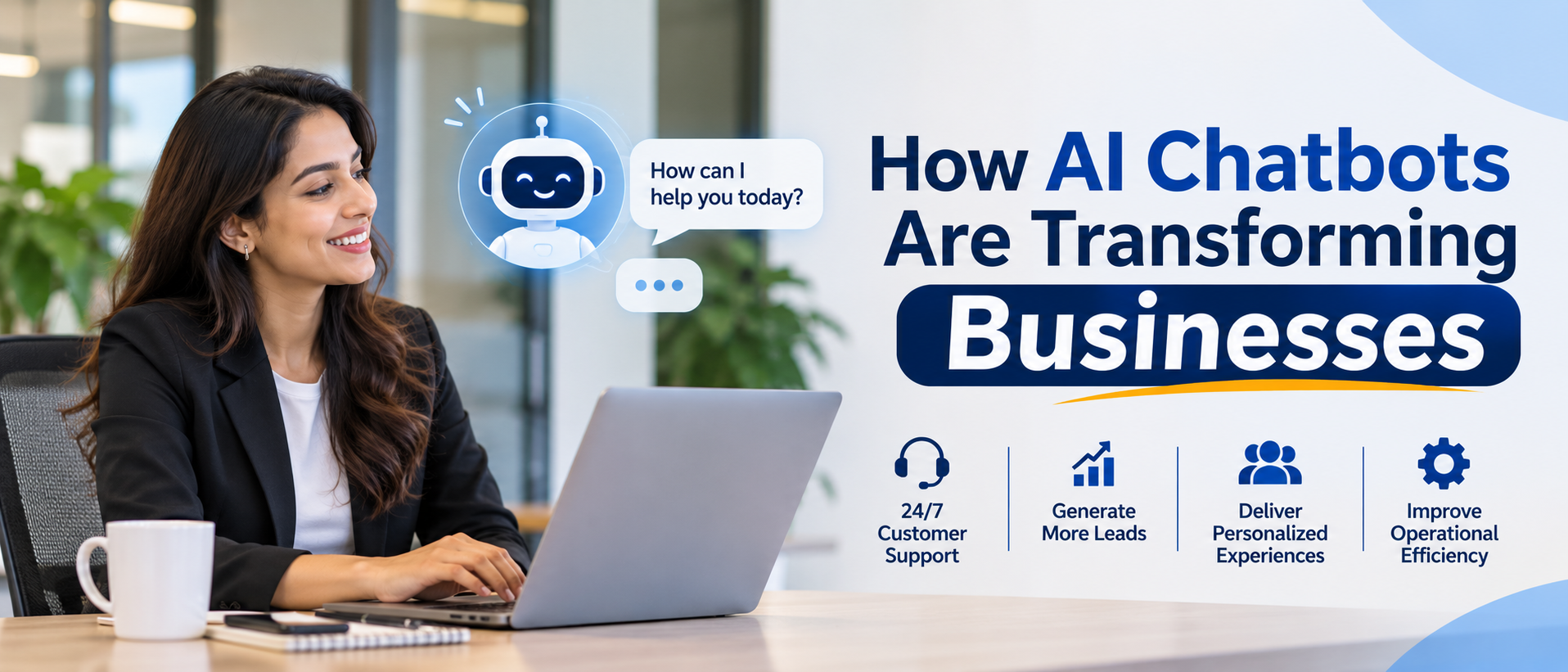
Artificial Intelligence (AI) is transforming the way businesses operate, communicate with customers, and manage everyday tasks. Among the most impactful AI technologies, AI chatbots have emerged as powerful tools that help businesses improve customer experiences, automate operations, generate leads, and increase overall productivity.
In 2026, AI chatbots are no longer limited to answering basic customer questions. Modern AI-powered chatbots can understand natural language, recognize customer intent, provide personalized recommendations, assist with purchases, qualify leads, and support complex business processes.
From small businesses and startups to large enterprises, organizations across industries are adopting AI chatbot solutions to stay competitive in an increasingly digital world.
But how exactly are AI chatbots transforming businesses in 2026? Let's explore their benefits, applications, industry use cases, and future potential.
What Are AI Chatbots?
AI chatbots are software applications powered by artificial intelligence that interact with users through text or voice conversations. They use technologies such as Natural Language Processing (NLP), Machine Learning (ML), and Large Language Models (LLMs) to understand questions and generate relevant responses.
Unlike traditional rule-based chatbots that follow predefined scripts, modern AI chatbots can understand different ways of asking questions and respond more naturally.
For example, a traditional chatbot may only respond to a specific keyword such as "pricing." An AI chatbot can understand questions like:
- How much does your service cost?
- Can you share your pricing details?
- What is the most affordable package?
- Do you offer customized pricing?
This ability to understand context makes AI chatbots more useful, flexible, and effective for business communication.
Why Are Businesses Adopting AI Chatbots in 2026?
Customer expectations are changing rapidly. People want quick answers, personalized experiences, and convenient communication without waiting for business hours.
At the same time, companies want to reduce repetitive workloads, improve operational efficiency, and manage increasing customer inquiries without continuously expanding their support teams.
AI chatbots help address these challenges.
Here are some major reasons why businesses are investing in AI chatbot technology:
- Customers expect immediate responses and convenient support.
- Businesses want to automate repetitive customer interactions.
- Companies need better ways to capture and qualify leads.
- Organizations want to reduce operational costs.
- Personalized customer experiences are becoming increasingly important.
- Businesses need scalable customer communication solutions.
AI chatbots provide a practical way to achieve these objectives while allowing employees to focus on more important tasks.
10 Ways AI Chatbots Are Transforming Businesses in 2026
1. Providing 24/7 Customer Support
One of the biggest advantages of AI chatbots is their ability to provide customer assistance around the clock.
Traditional customer support teams generally operate during specific working hours. However, customers may visit a website or require assistance at any time.
AI chatbots can respond to common questions, provide product information, explain services, and guide customers through basic troubleshooting processes, even outside business hours.
For example, an e-commerce customer may want to know the delivery status of an order at midnight. An AI chatbot connected to the company's order management system can retrieve the relevant information and provide an answer.
This helps businesses improve accessibility and maintain consistent communication with customers.
2. Automating Lead Generation and Qualification
Generating quality leads is essential for business growth. However, manually collecting customer information and identifying potential prospects can consume significant time.
AI chatbots can automate important parts of the lead generation process.
When a visitor lands on a website, an AI chatbot can initiate a conversation, understand their requirements, ask relevant questions, and collect essential information.
For example, a chatbot for a software development company can ask visitors:
- What type of software are you looking to develop?
- What is your estimated project budget?
- When would you like to start the project?
- Which features are important for your business?
Based on the responses, the chatbot can identify potential customers and forward qualified leads to the sales team.
This allows businesses to engage website visitors more effectively and reduce the chances of losing valuable opportunities.
3. Delivering Personalized Customer Experiences
Modern customers expect businesses to understand their preferences and provide relevant recommendations.
AI chatbots can use available customer information, conversation history, and connected business data to deliver more personalized interactions.
For example, an online shopping chatbot can recommend products based on a customer's preferences, previous purchases, or browsing activity, when the appropriate data and permissions are available.
Similarly, a chatbot for a travel company can suggest destinations, accommodation options, and travel packages based on a customer's requirements.
Personalized conversations can make customers feel more supported and help businesses create better customer experiences.
4. Reducing Operational Costs
Managing large volumes of customer inquiries requires time, resources, and trained employees.
AI chatbots can handle many repetitive interactions automatically, reducing the workload on customer support teams.
Instead of answering the same questions repeatedly, employees can focus on complex customer issues, sales opportunities, and business development activities.
For example, an AI chatbot can automatically answer questions about:
- Business working hours
- Product availability
- Pricing information
- Shipping and delivery
- Appointment scheduling
- Return and refund policies
- Frequently asked questions
AI chatbots do not eliminate the need for human employees. Instead, they help organizations use their workforce more efficiently.
5. Improving Sales and Conversion Rates
AI chatbots can play an important role throughout the customer buying journey.
They can engage visitors, explain product features, recommend suitable solutions, answer objections, and guide potential customers toward the next step.
For example, if a visitor is exploring a company's website development services, an AI chatbot can explain available packages, understand the visitor's project requirements, and help them schedule a consultation.
By providing timely information and reducing communication barriers, chatbots can support better conversion opportunities.
Businesses can also use chatbot conversations to identify common customer concerns and improve their sales strategies.
6. Streamlining Appointment Booking and Scheduling
Businesses such as healthcare organizations, educational institutions, consulting firms, salons, and service providers frequently manage appointment requests.
AI chatbots can simplify this process by allowing customers to check available slots, select suitable dates, provide contact details, and receive booking confirmations.
When integrated with scheduling systems, chatbots can also help customers reschedule or cancel appointments.
This reduces manual coordination and makes the booking experience more convenient.
7. Supporting Multilingual Customer Communication
Businesses increasingly serve customers from different regions and linguistic backgrounds.
Language barriers can make communication difficult, particularly for organizations operating across multiple countries.
Modern AI chatbots can support multiple languages, helping businesses communicate with customers in their preferred language, depending on the chatbot model and configuration.
For example, an Indian business may use an AI chatbot to assist customers in English, Hindi, Telugu, Tamil, and other supported languages.
Multilingual chatbot capabilities can help organizations improve accessibility and reach a broader customer base.
8. Automating Internal Business Processes
AI chatbots are not just useful for external customer communication. They can also support employees and internal business operations.
Organizations can deploy internal AI assistants to help employees find information, access documentation, answer HR-related questions, and navigate company processes.
For example, an employee can ask an internal chatbot:
- How many leaves do I have remaining?
- Where can I find the company's HR policy?
- How do I submit an expense reimbursement?
- What is the process for requesting IT support?
When connected to approved internal systems, AI assistants can retrieve relevant information and guide employees through workflows.
This reduces repetitive administrative tasks and improves internal productivity.
9. Enhancing E-commerce Customer Experiences
The e-commerce industry is one of the major beneficiaries of AI chatbot technology.
Online stores receive questions about products, availability, payments, delivery, returns, and order tracking.
AI chatbots can help customers throughout their shopping journey.
Some common applications include:
- Product recommendations
- Product comparisons
- Order tracking
- Shopping assistance
- Payment-related guidance
- Return and refund support
- Frequently asked questions
For example, a customer looking for a laptop can describe their budget and requirements. An AI chatbot can recommend suitable products from the store's available catalog.
This makes online shopping more interactive and helps businesses provide assistance at different stages of the purchasing process.
10. Improving Business Decision-Making Through Customer Insights
Every customer interaction can provide useful information about customer needs, expectations, and challenges.
AI chatbot systems can help businesses analyze conversation patterns, frequently asked questions, common complaints, and customer feedback.
These insights can help organizations understand:
- What customers are looking for.
- Which products or services receive the most inquiries.
- What problems customers frequently experience.
- Why potential customers may not complete purchases.
- Which areas of customer support need improvement.
Businesses can use these insights to improve products, refine marketing campaigns, and make more informed decisions.
AI Chatbot Applications Across Different Industries
AI chatbot technology is useful across various industries. Its applications depend on business requirements, customer expectations, and available integrations.
Healthcare
Healthcare organizations can use AI chatbots to assist with appointment scheduling, general service information, patient FAQs, and appointment reminders.
Chatbots can also help patients navigate administrative processes. However, sensitive medical information and clinical decisions require appropriate privacy safeguards and professional oversight.
Banking and Finance
Banks and financial institutions can use AI chatbots to answer general account-related questions, explain banking services, guide customers through common processes, and provide transaction assistance through secure integrations.
Sensitive financial operations should always require appropriate authentication and authorization.
Education
Educational institutions can deploy AI chatbots to answer admission questions, share course information, explain application procedures, provide campus information, and support student inquiries.
They can also help students access learning resources and administrative information.
Retail and E-commerce
Retail businesses can use AI chatbots to recommend products, provide order updates, answer shopping-related questions, and assist customers with returns and exchanges.
Real Estate
Real estate companies can use AI chatbots to respond to property inquiries, share listing information, understand buyer requirements, schedule property visits, and qualify potential leads.
Travel and Hospitality
Hotels, travel agencies, and tourism companies can use AI chatbots to provide booking assistance, explain travel packages, answer frequently asked questions, and share reservation information.
AI Chatbots vs. Traditional Chatbots: What's the Difference?
Although both technologies help automate conversations, they work differently.
Traditional Chatbots
Traditional chatbots primarily follow predefined rules, decision trees, and keyword-based instructions.
Their limitations include:
- Limited understanding of customer intent.
- Dependence on predefined conversation flows.
- Difficulty handling unexpected questions.
- Limited personalization.
- Less flexibility when conversations change direction.
AI-Powered Chatbots
AI chatbots use technologies such as NLP, machine learning, and language models to understand and respond to user requests.
Their advantages include:
- Better understanding of natural language.
- More flexible conversations.
- Context-aware responses.
- Personalized interactions.
- Ability to work with connected business systems.
- Support for more complex customer queries.
For businesses that receive diverse customer inquiries, AI-powered chatbots can offer greater flexibility than traditional rule-based systems.
Key Features to Look for in an AI Chatbot in 2026
Choosing the right AI chatbot is important for achieving meaningful business results.
Here are some essential features businesses should consider:
1. Natural Language Understanding: The chatbot should understand different ways customers ask questions.
2. Knowledge Base Integration: It should be able to retrieve accurate information from approved company documents, FAQs, and other business resources.
3. CRM Integration: Integration with customer relationship management systems can help businesses manage leads and customer interactions.
4. Multilingual Support: The chatbot should support the languages relevant to the business's target audience.
5. Lead Capture: It should collect relevant prospect information and support lead qualification.
6. Human Handover: Customers should be able to connect with a human representative when necessary.
7. Analytics and Reporting: Businesses should be able to monitor chatbot performance, customer interactions, and conversion-related metrics.
8. Security and Privacy: The chatbot should include appropriate access controls, data protection measures, and privacy safeguards.
9. Website and Platform Integration: It should work with the company's website and other relevant communication channels.
10. Scalability: The solution should be capable of supporting increasing customer interactions as the business grows.
Challenges of Implementing AI Chatbots
Despite their advantages, AI chatbots also come with certain challenges.
Businesses should understand these limitations before investing in chatbot development.
1. Incorrect or Incomplete Responses
AI chatbots can sometimes generate inaccurate information. Businesses should connect chatbots to reliable knowledge sources and establish clear response boundaries.
2. Data Privacy and Security
Chatbots may process personal or business-related information. Organizations must implement suitable security controls and comply with applicable data protection requirements.
3. Integration Complexity
Connecting chatbots with CRM platforms, databases, payment systems, and other business applications may require technical expertise.
4. Lack of Human Understanding
Although AI chatbots can understand language and context, they may not always handle emotional or highly sensitive customer situations appropriately.
Human support should remain available for complex interactions.
5. Initial Development and Maintenance
Building an effective AI chatbot requires planning, development, testing, integration, monitoring, and continuous improvement.
A successful implementation should be treated as an ongoing business solution rather than a one-time software installation.
How to Implement an AI Chatbot for Your Business
If you are planning to introduce an AI chatbot into your organization, following a structured approach can help you achieve better results.
Step 1: Identify Your Business Requirements
Determine what you want the chatbot to achieve. Your objective could be customer support automation, lead generation, sales assistance, appointment scheduling, or internal process automation.
Step 2: Understand Your Target Audience
Identify your customers' common questions, communication preferences, and expectations.
Step 3: Choose the Right AI Chatbot Solution
Select a chatbot platform or custom development approach based on your business requirements, technical needs, and budget.
Step 4: Prepare Your Knowledge Base
Provide accurate information about your products, services, policies, pricing, and frequently asked questions.
Step 5: Integrate Business Systems
Connect the chatbot with relevant systems such as CRM software, scheduling platforms, databases, or customer support tools.
Step 6: Test the Chatbot
Test different conversation scenarios, including unexpected questions, complex requests, and situations requiring human assistance.
Step 7: Launch and Monitor Performance
After deployment, monitor customer feedback, response accuracy, lead quality, resolution rates, and other relevant performance indicators.
Step 8: Continuously Improve
Regularly update the knowledge base, improve conversation flows, review chatbot performance, and introduce new capabilities when needed.
The Future of AI Chatbots: What's Next?
AI chatbot technology is continuing to evolve, creating new opportunities for businesses.
Several developments are expected to influence how organizations use chatbots in the coming years.
1. More Advanced Conversational AI
AI chatbots are becoming better at understanding context, handling follow-up questions, and maintaining more natural conversations.
2. Voice-Powered AI Assistants
Voice-enabled chatbots are making it easier for customers to interact with businesses through spoken conversations.
3. AI Agent Integration
AI chatbots are increasingly evolving into AI agents capable of performing tasks through connected business applications.
For example, instead of simply explaining how to schedule an appointment, an appropriately configured AI agent may check availability and complete the booking after receiving authorization.
4. Hyper-Personalized Customer Interactions
With appropriate access to customer preferences and business data, AI chatbots can provide more relevant recommendations and personalized assistance.
5. Omnichannel Communication
Businesses are moving toward consistent customer communication across websites, mobile applications, messaging platforms, and other digital channels.
6. Greater Focus on Responsible AI
As AI adoption increases, businesses will place greater emphasis on data privacy, transparency, security, accuracy, and human oversight.
These developments indicate that AI chatbots will continue to play an important role in digital business transformation.
Conclusion
AI chatbots are transforming how businesses communicate with customers, generate leads, automate repetitive tasks, and manage daily operations in 2026.
From providing 24/7 customer support to improving sales opportunities and streamlining internal workflows, AI chatbots offer practical benefits across industries.
However, successful implementation requires more than simply adding a chatbot to a website. Businesses need the right technology, accurate data, effective integrations, strong security measures, and continuous performance monitoring.
Organizations that adopt AI chatbot solutions strategically can improve operational efficiency, deliver better customer experiences, and build a stronger foundation for future growth.
Ready to Transform Your Business with AI Chatbots?
At Spectrum Future Tech, we believe intelligent automation can help businesses work smarter and serve customers better.
Whether you want to automate customer support, generate qualified leads, improve customer engagement, or build a customized AI chatbot solution, the right technology can make a meaningful difference.
Explore how AI-powered solutions can support your business transformation and help you stay competitive in the digital era.
Contact Spectrum Future Tech today to discuss your AI chatbot development requirements and discover the right solution for your business.