

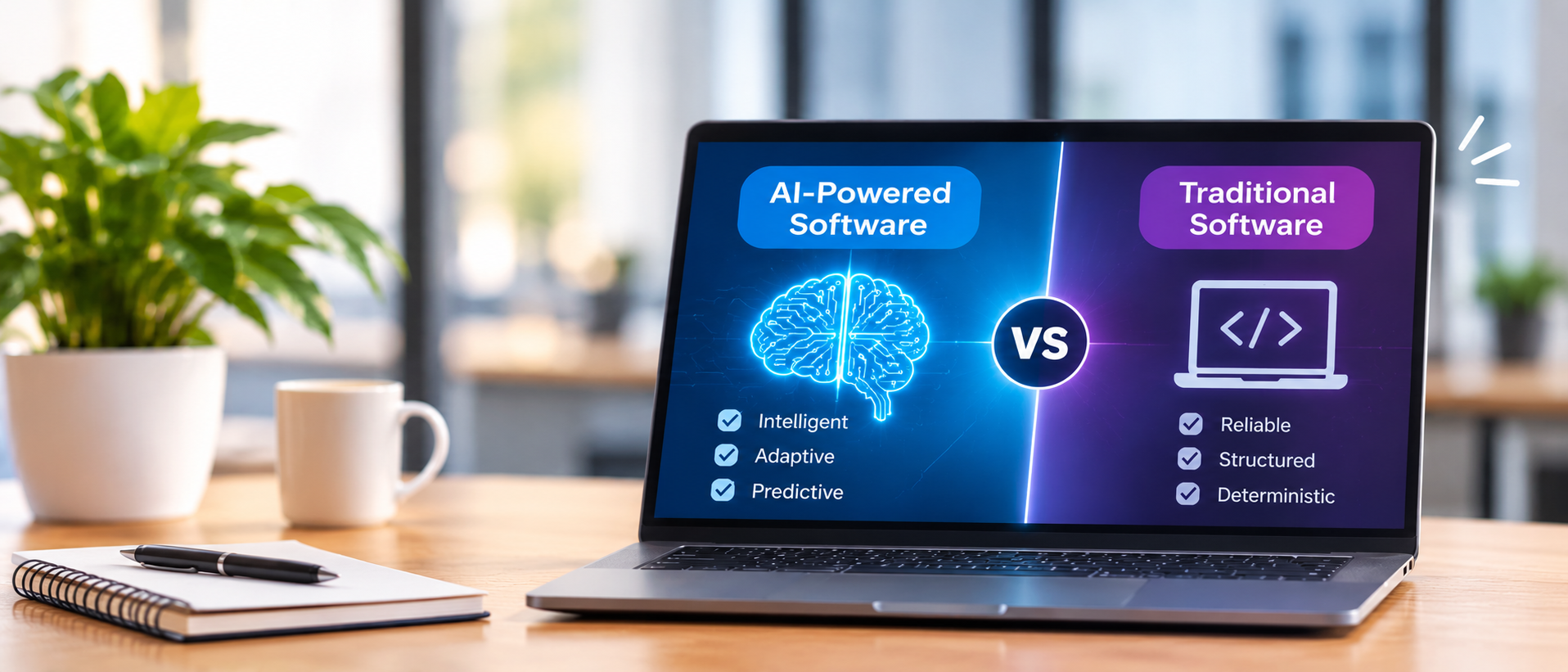
AI-Powered Software vs Traditional Software: How to Choose the Right Development Approach for Your Business
Businesses today have more options than ever when developing software. Traditional software development continues to power essential business applications, while artificial intelligence is making it possible to build applications that can understand language, identify patterns, generate content, analyse information, and support complex decisions.
This has created an important question for business leaders: Should you choose AI-powered software or traditional software development for your next project?
The answer is not as simple as choosing the newer technology. Both approaches solve different types of problems, and selecting the wrong one can introduce unnecessary complexity, operational risks, and development challenges.
For example, a company building an employee attendance system may not need artificial intelligence. Clearly defined rules and conventional application logic can handle the requirements effectively. However, a business that wants to analyse thousands of customer conversations, understand customer sentiment, or provide intelligent recommendations may benefit significantly from AI-powered software.
Understanding AI Development vs Traditional Software Development is therefore essential before investing in a new application or modernising an existing business system.
This guide explains how the two approaches work, their key differences, practical business applications, limitations, and how to decide which development approach best fits your organisation.
What Is Traditional Software Development?
Traditional software development is the process of designing, building, testing, deploying, and maintaining applications using predefined instructions and programming logic.
Developers write code that tells an application exactly what actions to perform when specific conditions are met. The software follows these rules to process information and produce expected results.
For example, consider an online ordering application. When a customer places an order, the software follows a predefined workflow:
- Accept the customer's order.
- Validate product availability.
- Calculate the order amount.
- Process the payment.
- Update inventory.
- Generate an order confirmation.
Every step follows business rules defined during development. If the same valid input is provided under the same conditions, the application generally produces the same result.
Traditional software development is widely used for building:
- Customer relationship management (CRM) systems
- Enterprise resource planning (ERP) platforms
- E-commerce applications
- Banking and payment systems
- Inventory management software
- Employee management platforms
- Customer portals and dashboards
- Booking and appointment systems
- Business workflow applications
- Web and mobile applications
How Traditional Software Works
Traditional applications generally rely on a combination of application logic, databases, APIs, and user interfaces.
A simplified workflow looks like this:
- A user enters information or acts.
- The application receives the request.
- The system checks the request against predefined rules.
- The application retrieves or updates relevant database records.
- The system returns the expected result.
For instance, a billing application calculates taxes using predefined tax rules. It does not need to understand the meaning of a customer's conversation or learn from historical patterns to complete the calculation.
This makes traditional software particularly useful when businesses need predictable workflows, accurate calculations, consistent transactions, and clearly defined system behaviour.
What Is AI-Powered Software Development?
AI-powered software development involves building applications that use artificial intelligence technologies to perform tasks that traditionally require human interpretation, pattern recognition, prediction, or language understanding.
Instead of relying entirely on manually programmed rules, AI-powered applications use models and data to interpret information and generate outputs.
Depending on the application, these systems may use:
- Machine learning (ML)
- Generative AI
- Large language models (LLMs)
- Natural language processing (NLP)
- Computer vision
- Predictive analytics
- Recommendation systems
- AI agents and intelligent automation
For example, a traditional customer support application might direct a ticket to a department based on a category selected by the customer.
An AI-powered support system can analyse the customer's message, understand its context, identify the likely issue, suggest a response, and route the request to the appropriate team.
AI-powered software can support businesses with:
- Intelligent customer support
- Automated document processing
- Predictive business analytics
- Personalised recommendations
- Natural language search
- Internal knowledge assistants
- Intelligent workflow automation
- Customer sentiment analysis
- Demand forecasting
- AI-driven decision support
How AI-Powered Software Works
An AI-powered application typically combines conventional software components with one or more AI models.
A simplified workflow may look like this:
- A user submits a question, document, image, or other input.
- The application processes the input and prepares relevant context.
- An AI model analyses the information.
- The system generates a prediction, recommendation, classification, or response.
- The application validates the result and applies relevant business rules.
- The result is presented to the user or passed to an approved workflow.
For example, an AI-powered document processing application can extract information from invoices, identify important fields, compare them with purchase orders, and flag discrepancies for human review.
The application does not need a developer to manually define every possible invoice layout or wording variation. Instead, an AI model can interpret different document formats, subject to its capabilities and appropriate validation.
However, AI outputs are not automatically correct. Their reliability depends on the model, input quality, application design, evaluation process, and safeguards.
AI Development vs Traditional Software Development: Key Differences
Both approaches share important software engineering foundations, including programming, databases, APIs, security, testing, and deployment.
The main difference is how they process information and produce results.
Traditional software primarily executes explicitly defined logic, while AI-powered software introduces models that interpret data, recognise patterns, and generate probabilistic outputs.
Here are the most important differences businesses should understand.
1. Rule-Based Logic vs Data-Driven Intelligence
Traditional software follows instructions written by developers.
For example, an inventory management system can automatically generate a low-stock notification when a product's quantity falls below a predefined threshold.
The rule might be:
- If available stock is below 20 units, generate an alert.
- If available stock is zero, mark the product as unavailable.
- If new inventory arrives, update the stock quantity.
The system follows these conditions consistently.
AI-powered software works differently. It can analyse historical sales, seasonal patterns, customer behaviour, and other available information to predict which products may experience increased demand.
The distinction is important:
- Traditional software executes predefined business rules.
- AI-powered software identifies patterns and generates predictions or recommendations based on data.
Which approach is better?
Use traditional software when the business rules are clear, and the expected outcome must be consistent.
Consider AI when the application needs to interpret information, identify patterns, or make predictions that are difficult to describe through fixed rules alone.
2. Structured Data vs Unstructured Data
Traditional software commonly works with structured information such as customer records, transaction details, product IDs, dates, and numerical values.
These systems are designed to store, retrieve, validate, and process information according to predefined formats.
AI-powered software can also work with structured data, but it offers additional capabilities for processing unstructured information.
Examples include:
- Emails and customer conversations
- PDF documents
- Images and scanned invoices
- Audio recordings
- Product descriptions
- Customer feedback
- Contracts and business reports
Imagine a company receiving hundreds of customer emails every day.
A traditional application can identify messages containing predefined words or phrases. However, understanding the actual meaning of different expressions can require extensive rule creation.
An AI-powered application can interpret the message, identify the customer's intent, recognise sentiment, and suggest an appropriate response.
This is particularly useful when information arrives in different formats or when the meaning depends on context.
3. Predictable Outputs vs Probabilistic Outputs
One of the most important differences between traditional and AI-powered software is how they produce results.
Traditional applications generally follow deterministic logic. Given the same input and system conditions, they are designed to return the same expected output.
AI models, particularly generative AI models, work probabilistically. Their outputs can vary depending on the input, context, model configuration, and other factors.
For example:
A traditional tax calculator applies predefined formulas to calculate tax based on the supplied values.
An AI-powered financial assistant may interpret a user's question, retrieve relevant financial information, and explain possible implications in natural language.
The calculator is responsible for exact calculations. The AI assistant is useful for interpreting questions and explaining information.
This is why AI should not automatically replace conventional application logic for calculations, financial transactions, access permissions, or other operations that require strict accuracy.
A well-designed application often uses AI for interpretation and traditional software logic for validation and execution.
4. Development Process and Implementation
Traditional software development usually begins with requirements gathering, system design, architecture planning, coding, testing, and deployment.
Although modern development teams use iterative approaches such as Agile, the expected behaviour is generally defined before implementation.
AI development requires additional experimentation and evaluation.
Teams may need to:
- Identify the right AI model.
- Prepare and validate relevant data.
- Select an appropriate model integration strategy.
- Design prompts and system instructions.
- Connect the model with business applications.
- Evaluate output accuracy and consistency.
- Test unusual inputs and edge cases.
- Introduce human review and approval mechanisms.
- Monitor model performance after deployment.
For example, building a conventional employee leave management application requires predefined leave policies, approval workflows, employee records, and notifications.
Building an AI-powered HR assistant introduces additional requirements. The system must understand employee questions, retrieve relevant HR policies, respect access permissions, and provide answers grounded in approved company information.
AI development therefore requires both software engineering and additional AI-specific design and evaluation.
5. Data Requirements and Preparation
Traditional software can often operate using predefined business rules and structured database records.
AI-powered software usually requires suitable data to perform its intended task. The exact requirements depend on the AI approach.
A machine learning model may need historical, labelled examples for training and evaluation. A generative AI application may use an existing model and retrieve relevant business information at runtime instead of training a new model.
For example, an organisation building an internal AI knowledge assistant may need to connect company documents, policies, and approved knowledge sources.
Before implementation, the team should examine:
- Data availability
- Data accuracy and completeness
- Data ownership
- Access permissions
- Privacy requirements
- Data quality and consistency
- Relevance to the intended use case
Poor-quality or outdated information can reduce the usefulness of an AI application.
This is why data preparation and governance should be considered early in an AI project rather than treated as tasks that can be completed after development.
6. Testing and Quality Assurance
Testing is essential for both traditional and AI-powered applications, but the evaluation methods are different.
Traditional software testing checks whether the application performs according to its specifications.
For example:
- Does the login process work correctly?
- Does the payment gateway process transactions?
- Are calculations accurate?
- Does the application save information correctly?
- Are user permissions enforced?
AI-powered applications require these tests as well as AI-specific evaluation.
Additional testing may include:
- Response accuracy
- Relevance of generated answers
- Hallucination detection
- Bias and fairness
- Prompt injection resistance
- Data leakage risks
- Model behaviour under unusual inputs
- Consistency across different scenarios
- Performance after model or data changes
Consider an AI-powered customer support assistant.
It is not enough to verify that the chatbot opens and responds to a question. The team must also evaluate whether its answers are relevant, grounded in approved information, safe, and appropriate for the customer's situation.
For high-impact decisions, the system may also require human review before taking action.
7. Maintenance and Continuous Improvement
Traditional applications need regular maintenance to fix bugs, update dependencies, improve performance, and support changing business requirements.
AI-powered applications require these activities too, but they introduce additional monitoring responsibilities.
Depending on the solution, teams may need to monitor:
- Model performance
- Response accuracy
- Data quality
- Changes in user behaviour
- Model or API updates
- Inference performance
- Security and access controls
- Changes in business information
- AI usage patterns
For example, an AI recommendation system may initially perform well but become less relevant as customer preferences change.
The organisation needs to evaluate whether the model, data, or recommendation logic requires improvement.
AI maintenance is therefore not simply about keeping the application operational. It also involves ensuring that the intelligent components continue to deliver useful and reliable results.
8. Security, Governance, and Human Oversight
Security is important in every software development project.
Traditional applications require secure authentication, authorisation, encryption, application security testing, and appropriate data protection.
AI-powered applications introduce additional considerations.
For example, an internal AI assistant may access company documents and respond to employee questions. If access permissions are not properly implemented, the system could expose information to people who should not see it.
Businesses should consider:
- Role-based access control
- Identity and authentication
- Data privacy and retention
- Secure model and API integration
- Prompt injection protection
- Output validation
- Audit logging
- Human approval for sensitive actions
- Monitoring and incident response
Human oversight is especially important when AI recommendations can influence financial, legal, healthcare, employment, or other high-impact decisions.
The NIST AI Risk Management Framework guides identifying, assessing, and managing risks throughout the AI system lifecycle.
The objective should not be to add AI as quickly as possible. It should be to build an application that is useful, secure, accountable, and appropriate for its intended purpose.
AI-Powered Software vs Traditional Software: Comparison at a Glance
The following comparison summarises the main differences.
| Comparison Area | Traditional Software | AI-Powered Software |
|---|---|---|
| Core approach | Predefined programming logic | AI models combined with application logic |
| Decision-making | Follows programmed rules | Identifies patterns and generates predictions or responses |
| Data requirements | Often structured business data | Can use structured and unstructured data |
| Output | Generally predictable | May vary depending on model behaviour and context |
| Development | Requirements, architecture, coding, and testing | Software engineering plus model integration and AI evaluation |
| Testing | Functional, integration, security, and performance testing | Traditional testing plus accuracy, safety, and model evaluation |
| Adaptability | Changes usually require code or rule updates | May adapt through model updates, new data, or configuration |
| Maintenance | Application and infrastructure maintenance | Application, infrastructure, data, and model monitoring |
| Best suited for | Clearly defined workflows and exact operations | Interpretation, prediction, generation, and complex information processing |
| Human oversight | Depends on the business process | Often important for uncertain or high-impact outputs |
Neither approach is universally better. The right choice depends on the problem the software needs to solve.
Real-World Business Examples: When Should You Use AI or Traditional Software?
Understanding the technical differences is useful, but business leaders also need to know how these approaches work in real situations.
Here are practical examples across different business functions.
1. Customer Relationship Management
A traditional CRM system stores customer information, tracks interactions, manages sales pipelines, and records follow-up activities.
It works well for managing structured sales processes.
An AI-powered CRM can add capabilities such as:
- Summarising customer conversations
- Identifying potential sales opportunities
- Analysing customer sentiment
- Recommending follow-up actions
- Predicting potential customer churn
- Helping sales teams retrieve information using natural language
Recommended approach: Combine both.
The traditional CRM should remain responsible for customer records, permissions, and transaction-related workflows. AI can assist with analysis, recommendations, and information retrieval.
2. Inventory and Supply Chain Management
A traditional inventory system manages product quantities, purchase orders, warehouse records, stock transfers, and reorder rules.
It is suitable for operations that depend on accurate and consistent records.
AI can enhance the system by:
- Forecasting product demand
- Identifying unusual inventory patterns
- Predicting potential stock shortages
- Analysing supplier performance
- Recommending inventory replenishment
Recommended approach: Use traditional software for inventory records and transactions, with AI for forecasting and decision support.
3. Customer Support Applications
Traditional support software manages customer tickets, assigns requests, records conversations, and tracks service-level agreements.
AI-powered support applications can understand customer questions, summarise conversations, retrieve relevant knowledge articles, and suggest responses.
For example, a customer asking why a payment failed may receive an AI-generated explanation based on approved transaction information and support documentation.
Recommended approach: Use AI to assist with understanding and responding to customer requests, while traditional workflows manage ticket records, permissions, escalations, and approvals.
4. Financial and Accounting Applications
Traditional accounting software is essential for recording transactions, calculating balances, processing invoices, and maintaining financial records.
AI can support these applications through:
- Invoice data extraction
- Expense classification
- Unusual transaction detection
- Financial document analysis
- Forecasting and reporting assistance
However, AI-generated financial recommendations should not automatically replace validated accounting calculations or authorised financial controls.
Recommended approach: Use traditional software for financial records and calculations. Apply AI to document processing, analysis, and assistance with appropriate verification.
5. Human Resources Management
Traditional HR software manages employee records, attendance, payroll workflows, leave requests, and recruitment processes.
AI can support HR teams by:
- Answering questions about company policies
- Summarising recruitment documents
- Analysing workforce trends
- Assisting with employee onboarding
- Automating routine HR communications
AI used in recruitment or employee evaluation requires particular care because biased or inaccurate outputs can affect people.
Recommended approach: Combine conventional HR workflows with carefully governed AI assistance. Keep sensitive employment decisions subject to appropriate human review.
6. Healthcare Applications
Traditional healthcare software manages patient records, appointments, billing, clinical workflows, and administrative operations.
AI can support healthcare organisations through:
- Medical document processing
- Clinical information retrieval
- Medical image analysis
- Administrative workflow assistance
- Patient communication support
AI-generated outputs must be validated for the intended clinical context. They should not be treated as a substitute for qualified medical judgement.
Recommended approach: Use traditional software for essential records and operational workflows. Introduce AI for specific, validated tasks with appropriate clinical oversight.
When Is Traditional Software Development the Better Choice?
AI is receiving considerable attention, but not every business application needs artificial intelligence.
Traditional software development is often the better option when:
1. The Business Rules Are Clearly Defined
If an application performs predictable tasks based on established rules, conventional programming may be sufficient.
Examples include tax calculations, invoice generation, attendance tracking, and order processing.
2. The Application Requires Exact Results
Applications that perform financial calculations, transaction processing, and critical data updates generally require predictable and verifiable logic.
AI may assist users, but the underlying calculations and transaction rules should remain controlled by conventional software.
3. The Workflow Is Stable and Repetitive
A process that follows the same steps every time does not necessarily need AI.
For example, an approval system that sends a request to a manager based on a predefined reporting structure can operate effectively using traditional workflow logic.
4. Data Is Limited or Not Suitable for AI
Some AI applications require relevant data, examples, or knowledge sources.
If the organisation does not have suitable data and the problem can be solved through conventional programming, traditional development may be the more practical starting point.
5. The Business Does Not Need Intelligent Interpretation
A simple customer portal, booking application, product catalogue, or employee dashboard may not benefit from AI at all.
Adding AI without a clear business purpose can introduce unnecessary dependencies and maintenance requirements.
The key principle: Choose traditional software when the problem can be solved reliably through clearly defined rules and workflows.
When Should Businesses Choose AI-Powered Software Development?
AI-powered software becomes valuable when a business needs capabilities that are difficult to achieve through conventional programming alone.
Consider AI development when:
1. The Application Needs to Understand Natural Language
If users need to interact with software through everyday language rather than structured forms or predefined commands, AI can provide a more flexible experience.
Examples include internal knowledge assistants, conversational search, and customer support applications.
2. The Business Processes Large Amounts of Unstructured Information
AI can help organisations extract, classify, summarise, and interpret information from documents, emails, images, and other sources.
This can be useful for legal documentation, invoice processing, insurance claims, and enterprise knowledge management.
3. The Organisation Needs Predictive Insights
Businesses with relevant historical data may use machine learning to identify patterns and forecast future outcomes.
Examples include demand forecasting, predictive maintenance, customer churn analysis, and fraud detection.
Predictions should be evaluated against suitable real-world data before being used in operational decisions.
4. The Business Wants to Automate Complex Knowledge Work
Some processes involve interpreting information before deciding what action to take.
For example, an AI-powered workflow may read an incoming customer request, identify its intent, retrieve relevant information, and prepare a suggested response for an employee.
AI agents can extend this approach by interacting with approved tools and systems to complete defined tasks.
However, their permissions and actions should be carefully controlled.
5. The Application Needs Personalised Experiences
AI can analyse user behaviour, preferences, and available contextual information to support personalised recommendations and experiences.
Examples include product recommendations, content discovery, and personalised learning platforms.
The key principle: Choose AI-powered software when interpretation, prediction, language understanding, or intelligent automation provides measurable value that conventional rules alone cannot deliver efficiently.
Why Most Modern Business Applications Need a Hybrid Approach
One of the biggest misconceptions about AI development vs. traditional software development is that businesses must choose only one.
In practice, many modern applications combine both approaches.
Traditional software provides the foundation for managing users, databases, workflows, transactions, and system integrations. AI adds intelligence where it can improve how users interact with information or complete tasks.
Consider an AI-powered customer support platform.
Its architecture may include:
- A web application for customer and employee access
- A traditional backend to manage accounts and support tickets
- A database to store customer and ticket information
- APIs to connect external business applications
- An AI model to understand customer questions
- A knowledge retrieval system to access approved documentation
- Business rules to control ticket updates and escalation
- Monitoring tools to evaluate application and AI performance
In this example, AI does not replace the entire software application. It works as an intelligent component within a larger system.
Example: Building an AI-Powered Invoice Processing Application
Imagine an organisation that receives hundreds of invoices from different suppliers.
A traditional invoice management application can store invoice records, manage approvals, and track payment status.
However, employees may still need to manually review different invoice layouts and enter information.
A hybrid application can improve the process:
Step 1: Document upload
A supplier or employee uploads an invoice through the application.
Step 2: AI-based information extraction
An AI model or document processing system identifies information such as supplier name, invoice number, date, tax details, and total amount.
Step 3: Data validation
Traditional software checks the extracted information against predefined business rules and available purchase order records.
Step 4: Exception handling
If the invoice contains missing information, inconsistent values, or potential discrepancies, the application flags it for review.
Step 5: Approval workflow
The conventional application sends the invoice to the authorised employee for approval.
Step 6: Record management
After approval, the application updates the relevant financial records through controlled integrations.
This approach combines AI's ability to interpret documents with traditional software's ability to manage business rules and transactions.
The result is a more useful business application than either technology might provide on its own.
How to Choose the Right Software Development Approach for Your Business
Before selecting a development approach, organisations should evaluate the actual business problem rather than starting with a preferred technology.
The following framework can help.
Step 1: Identify the Business Problem
Start by understanding what the application needs to achieve.
Ask questions such as:
- Which business process needs improvement?
- What problem are employees or customers experiencing?
- Is the process repetitive or information-intensive?
- Does it require interpretation or decision-making?
- What outcome would make the application successful?
Avoid choosing AI simply because it is a popular technology.
Step 2: Understand the Nature of the Task
Determine whether the application needs to execute predefined rules or interpret complex information.
For example:
- Calculating an invoice total: traditional software.
- Extracting information from different invoice formats: AI-assisted processing.
- Approving an invoice based on company policy: traditional workflow with appropriate authorisation.
- Identifying unusual invoice patterns: potentially AI-assisted analysis.
This distinction helps identify where AI adds genuine value.
Step 3: Evaluate Data Availability and Quality
If the project requires AI, assess whether the organisation has suitable information to support the intended functionality.
Consider:
- What data is available?
- Is it accurate and current?
- Is the organisation authorised to use it?
- Does it contain sensitive information?
- Can the AI system access only the information it is permitted to use?
- Is the information sufficient to evaluate the intended outcome?
If data readiness is uncertain, an AI readiness audit can help identify the organisational, data, and technical considerations that should be addressed before implementation.
Step 4: Assess Risk and Reliability Requirements
Not every task has the same consequences when something goes wrong.
A recommendation displayed on an internal dashboard may have a different risk profile from an AI system that initiates financial transactions or influences healthcare decisions.
Evaluate:
- What happens if the application produces an incorrect result?
- Does the task require human approval?
- Can the system verify its output?
- Is an audit trail required?
- What information can the application access?
- Can the business safely reverse an action?
The higher the potential impact, the more important validation, permissions, monitoring, and human oversight become.
Step 5: Decide Whether a Hybrid Architecture Is More Appropriate
Many business requirements can be divided into two categories:
- Tasks requiring predictable execution.
- Tasks benefiting from intelligent interpretation or analysis.
Use traditional software for the first category and AI for the second.
This approach helps businesses introduce AI without unnecessarily replacing stable systems.
Step 6: Validate the Solution Before Scaling
Start with a clearly defined use case and measurable success criteria.
For an AI application, evaluate output quality, reliability, security, and user acceptance. For traditional software, validate functional requirements, integration behaviour, and operational performance.
A pilot or proof of concept can help establish whether the proposed solution works under realistic conditions.
Once the approach is validated, the organisation can plan a broader implementation.
Common Mistakes Businesses Should Avoid When Choosing Between AI and Traditional Software
Selecting a development approach without understanding its limitations can create problems later.
Here are some common mistakes worth avoiding.
1. Adding AI Without a Clear Business Requirement
AI should solve a genuine problem.
Adding a chatbot, recommendation engine, or AI feature simply to make an application appear modern may not improve the user experience or business outcomes.
Start with the business requirement and identify whether AI is necessary.
2. Assuming AI Can Replace All Traditional Software
AI applications still depend on conventional software components.
They need databases, APIs, authentication, permissions, interfaces, integrations, and reliable workflows.
Even advanced AI agents require controlled software environments in which to operate.
3. Ignoring Data Quality
AI outputs depend heavily on the quality and relevance of the information available to the system.
Disconnected, outdated, or inconsistent data can reduce the usefulness of an AI solution.
Data preparation and governance should be part of the implementation plan.
4. Treating AI-Generated Answers as Automatically Correct
AI models can generate incorrect, incomplete, or misleading information.
Applications should use suitable evaluation methods, output validation, access controls, and human review where required.
5. Overlooking Integration With Existing Systems
A new AI application may need to connect with CRM platforms, ERP systems, databases, internal documents, or other business applications.
If these integrations are not considered during architecture planning, the solution may work as a demonstration but struggle in real business operations.
6. Ignoring Long-Term Monitoring
Launching an application is not the end of development.
Both traditional and AI-powered applications need ongoing maintenance. AI systems also require monitoring of model behaviour, data quality, output performance, and changing business requirements.
The Future of Software Development: AI and Traditional Engineering Working Together
The future of software development is not simply about replacing traditional programming with artificial intelligence.
Instead, AI is becoming another important capability within the broader software engineering ecosystem.
Developers can use AI-assisted tools to support coding, documentation, testing, debugging, and code review. At the same time, AI-enabled applications are introducing new ways for businesses to interact with software and automate knowledge-intensive tasks.
Several developments are particularly important.
AI-Assisted Software Engineering
AI coding assistants can help developers generate code suggestions, explain unfamiliar code, write tests, and work through implementation problems.
However, generated code still needs to be reviewed, tested, secured, and maintained by qualified engineering teams.
AI Agents and Intelligent Workflows
AI agents can use approved tools and systems to complete multi-step tasks.
For example, an enterprise AI agent might retrieve information from a knowledge base, prepare a report, and submit it for employee approval.
These systems still require conventional software architecture, controlled permissions, and monitoring.
Natural Language Interfaces
Applications are increasingly incorporating conversational interfaces that allow users to search information, ask questions, and interact with business systems using natural language.
This can make complex software easier to use, particularly when users need information from multiple systems.
More Intelligent Enterprise Applications
Businesses can integrate AI capabilities into existing applications rather than replacing entire platforms.
Examples include AI-powered search in document management systems, predictive insights in business dashboards, and intelligent assistance within CRM platforms.
Greater Focus on AI Governance
As AI becomes part of important business processes, organisations will need stronger practices for evaluating model behaviour, protecting information, managing access, and monitoring system performance.
The NIST AI Risk Management Framework offers a useful foundation for thinking about these responsibilities across the AI lifecycle.
The long-term direction is likely to involve a combination of conventional engineering, AI capabilities, and responsible system design.
Final Thoughts
Choosing between AI-powered software and traditional software development is ultimately a business decision, not simply a technology decision.
Traditional software remains essential for applications that require predictable behaviour, accurate transactions, structured workflows, and consistent execution. AI-powered software offers additional capabilities when businesses need to interpret information, recognise patterns, generate responses, or automate complex knowledge-based tasks.
For many organisations, the most practical solution is to combine both.
The important thing is to identify where AI can create meaningful value without introducing unnecessary complexity. A well-designed application should use the right technology for each task, maintain appropriate security controls, and deliver a measurable improvement to the people who use it.
If your organisation is planning to build a new application, modernise an existing platform, or introduce intelligent automation, Spectrum Future Tech can help you evaluate the right approach and plan an implementation aligned with your business requirements.
Explore our AI integration services, AI automation solutions, and AI agent development to understand how AI capabilities can work alongside your existing business systems.
Frequently Asked Questions
1. What is the difference between AI development and traditional software development?
Traditional software development uses predefined programming logic to perform specific tasks. AI development uses artificial intelligence models to interpret information, identify patterns, generate responses, or make predictions. Traditional software focuses on predictable execution, while AI introduces capabilities for handling tasks that require interpretation or learning from data.
2. Is AI-powered software better than traditional software?
Not necessarily. AI-powered software is useful for tasks involving language understanding, predictions, recommendations, and complex information processing. Traditional software is often better for predictable workflows, exact calculations, and transaction processing. The right approach depends on the business requirement.
3. Can AI replace traditional software development?
AI can automate or improve certain software development activities, but it cannot replace the need for reliable application architecture, databases, security, integrations, testing, and maintenance. Most production AI applications still rely on traditional software engineering.
4. What are the benefits of AI-powered software?
AI-powered software can help businesses automate knowledge-intensive tasks, analyse large amounts of information, understand natural language, generate content, identify patterns, and provide intelligent recommendations. Its benefits depend on the use case, data quality, implementation, and ability to integrate it into existing workflows.
5. When should a business choose traditional software development?
Traditional software development is suitable when an application needs to follow clear business rules, process transactions, perform accurate calculations, manage structured records, or execute predictable workflows. It is also appropriate when AI would add complexity without providing meaningful business value.
6. Can traditional software and AI work together?
Yes. Many modern applications combine traditional software with AI capabilities. Conventional application logic manages databases, transactions, user permissions, and workflows, while AI supports tasks such as document understanding, predictions, recommendations, and natural language interactions.
7. What industries can benefit from AI-powered software?
Industries such as healthcare, banking, insurance, retail, manufacturing, logistics, education, and professional services can benefit from AI-powered software. Common applications include document processing, forecasting, customer support, fraud detection, predictive maintenance, and intelligent knowledge management.
8. Does AI-powered software require large amounts of data?
Not every AI application requires a large custom training dataset. Some machine learning solutions need substantial relevant training data, while applications built using existing generative AI models may use retrieval, business documents, or structured information at runtime. Requirements depend on the selected technology and use case.
9. Is AI-powered software more difficult to maintain?
AI-powered software can introduce additional maintenance responsibilities because teams may need to monitor model performance, data quality, output accuracy, and model or API changes. However, both traditional and AI-powered applications require regular security updates, infrastructure maintenance, testing, and support.
10. What is a hybrid software development approach?
A hybrid approach combines traditional software engineering with AI capabilities. It uses conventional programming for predictable workflows, transactions, and validation, while AI handles tasks such as interpretation, prediction, and intelligent automation. This is often a practical approach for organisations modernising existing business applications.
11. Can AI be integrated into an existing business application?
Yes. AI capabilities can be introduced into existing applications through APIs, model integrations, data pipelines, and other software components. For example, a business can add an AI assistant to an existing CRM or connect document processing capabilities to an invoice management platform. The integration should account for data permissions, security, reliability, and user workflows.
12. How should a business start an AI software development project?
Start by identifying a specific business problem and evaluating whether AI is genuinely needed. Assess data readiness, security requirements, integration needs, and potential risks. Then define success criteria, validate the proposed solution through a suitable pilot, and plan the production implementation based on the results.