

Artificial Intelligence (AI) is transforming the way businesses operate, communicate with customers, manage operations, and make decisions. From answering customer questions to automating complex business processes, AI-powered technologies are becoming an essential part of modern business operations.
Two terms that frequently appear in discussions about business AI adoption are AI Agents and AI Chatbots.
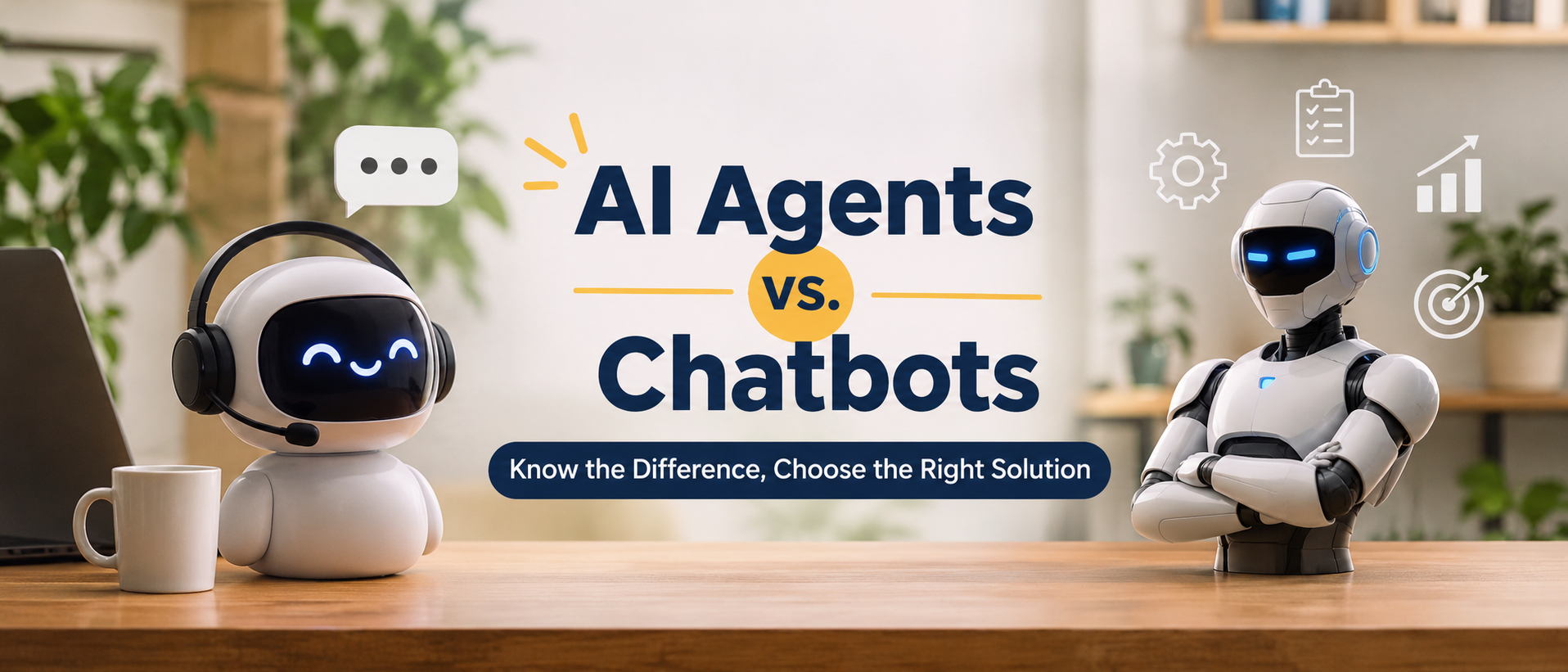
Although these technologies may seem similar because both can communicate with people using natural language, they serve different purposes. An AI chatbot primarily focuses on interacting with users, answering questions, and providing information. An AI agent goes a step further by understanding objectives, making decisions within defined boundaries, using connected tools, and completing tasks with limited human intervention.
For example, imagine a customer visiting an e-commerce website to check the status of an order.
A traditional chatbot can ask for an order number and provide the latest delivery information. An AI-powered chatbot can understand more complex questions and retrieve relevant information from a connected database.
An AI agent, however, could investigate a delayed shipment, check inventory, contact the logistics system, initiate an approved replacement or refund process, update the order record, and notify the customer.
This is the fundamental difference between the two technologies: chatbots are primarily designed for conversations, while AI agents are designed to accomplish goals and execute tasks.
However, does this mean AI agents are always better than chatbots? Not necessarily. Both technologies offer valuable business benefits, and the right choice depends on your organization's objectives, workflows, budget, and operational requirements.
In this comprehensive guide, we will explore AI Agents vs. Chatbots, how they work, their key differences, real-world applications, advantages, limitations, implementation considerations, and how businesses can choose the right solution.
1. What Is an AI Chatbot?
An AI chatbot is a software application designed to communicate with users through text or voice conversations. It uses artificial intelligence technologies, such as Natural Language Processing (NLP), machine learning, and Large Language Models (LLMs), to understand questions and generate relevant responses.
Unlike traditional customer support systems that require human agents to answer every inquiry, AI chatbots can handle many customer interactions automatically.
Businesses commonly deploy AI chatbots on:
- Company websites
- E-commerce platforms
- Mobile applications
- WhatsApp and other messaging platforms
- Customer support portals
- Social media platforms
- Internal employee communication systems
The primary purpose of an AI chatbot is to make communication faster, easier, and more accessible.
For example, a customer visiting a software company's website might ask:
"Do you provide custom software development services?"
The chatbot can understand the question, retrieve relevant information from its knowledge base, and respond with the company's available services.
Similarly, an AI chatbot can answer questions about pricing, product availability, business hours, delivery information, technical documentation, and frequently asked questions.
1.1 How Are AI Chatbots Different From Traditional Chatbots?
Not every chatbot uses artificial intelligence.
Traditional chatbots generally operate using predefined rules, keywords, decision trees, and scripted conversation flows.
For example:
- User: What are your business hours?
- Chatbot: We are available Monday to Friday, from 9 AM to 6 PM.
- User: I want to speak with customer support.
- Chatbot: Please select one of the following options.
These systems work well when users follow expected conversation paths. However, they can struggle when customers ask unexpected questions or use unfamiliar language.
AI-powered chatbots offer more flexibility.
They can understand natural language, interpret user intent, process different ways of asking the same question, and generate contextually relevant responses.
For instance:
A customer might ask:
- "When does your office open?"
- "What time can I contact your team?"
- "Are you available on Saturdays?"
- "Can I speak with someone today?"
An AI chatbot can understand the underlying intent rather than relying exclusively on exact keyword matches.
Important: An AI chatbot can also be connected to business applications and perform predefined actions. The difference is not simply whether it can execute an action, but how much decision-making, planning, and workflow control it has.
2. How Do AI Chatbots Work?
AI chatbots use several technologies working together to understand user messages and generate responses.
Here is a simplified explanation of the process.
Step 1: User Sends a Message
The process starts when a user enters a question or speaks to the chatbot.
For example:
"I want to know more about your AI development services."
The chatbot receives the message through a website, mobile application, messaging platform, or another communication channel.
Step 2: Natural Language Understanding
The chatbot processes the message using Natural Language Processing (NLP) and language models.
It attempts to identify:
- The user's intent
- Important keywords
- Relevant entities
- The context of the conversation
- The information being requested
In this example, the chatbot identifies that the user wants information about AI development services.
Step 3: Information Retrieval
Depending on its configuration, the chatbot retrieves information from:
- Predefined responses
- Frequently asked questions
- Company knowledge bases
- Product documentation
- Connected databases
- Retrieval-Augmented Generation (RAG) systems
RAG allows an AI system to retrieve relevant information from an external knowledge source before generating a response.
This can help businesses build chatbots that answer questions using their own company information rather than relying only on a language model's general knowledge.
Step 4: Response Generation
The AI model processes the available context and generates an appropriate response.
For example:
"Our AI development services include custom AI solutions, intelligent workflow automation, AI agent development, and generative AI integration."
Step 5: Response Delivery
The chatbot displays the response to the user.
Depending on its integrations, it may also provide links, collect contact information, create a support ticket, or transfer the conversation to a human representative.
Simple AI Chatbot Workflow
User Message → Language Understanding → Information Retrieval → Response Generation → User Response
This process is particularly useful for customer communication, answering repetitive questions, and providing round-the-clock assistance.
3. Types of AI Chatbots
AI chatbots are available in different forms depending on their capabilities and business requirements.
3.1 Rule-Based Chatbots
Rule-based chatbots follow predefined instructions and conversation flows.
They typically use buttons, menus, decision trees, and keyword matching.
Example: A restaurant chatbot that asks customers to select an option:
- View Menu
- Make a Reservation
- Check Delivery Status
- Contact Support
These chatbots are relatively simple to implement and work well for predictable interactions.
However, they have limited flexibility when users ask questions outside their predefined workflows.
3.2 AI-Powered Chatbots
AI-powered chatbots use NLP, machine learning, and language models to understand user intent and respond more naturally.
They can handle different sentence structures, conversational questions, and contextual interactions.
Example: A customer can ask a chatbot about a product's features, compare available options, and request recommendations without following a fixed menu.
3.3 Generative AI Chatbots
Generative AI chatbots use Large Language Models (LLMs) to generate responses based on user instructions and available context.
Unlike traditional scripted systems, they can produce original, context-aware responses.
Common applications include:
- Content generation
- Customer support
- Knowledge assistance
- Technical documentation
- Internal employee support
- Product recommendations
- Information summarization
3.4 Voice-Based AI Chatbots
Voice-based AI chatbots allow users to interact with systems through spoken conversations.
They typically combine speech recognition, language understanding, and text-to-speech technologies.
Businesses use voice chatbots for customer service, appointment scheduling, call routing, and automated information services.
4. What Are AI Agents?
AI agents are intelligent software systems designed to achieve specific objectives by understanding instructions, reasoning through tasks, making decisions, and taking actions using available tools and connected systems.
Unlike conventional chatbots, which primarily focus on responding to conversations, AI agents can work toward completing an entire task or workflow.
They can analyze information, determine what needs to happen next, interact with APIs, access databases, use business applications, and evaluate the results of their actions.
The main objective of an AI agent is not simply to answer a question. It is to accomplish a defined goal.
Consider an example involving a company's sales department.
A business receives a new lead through its website.
A conventional chatbot might collect the visitor's name, email address, and business requirements.
An AI agent could potentially:
- Collect the lead's information.
- Analyze the company's requirements.
- Identify the relevant service category.
- Research available information about the prospect.
- Update the CRM system.
- Assign the lead to the appropriate sales representative.
- Schedule a meeting based on availability.
- Send a personalized confirmation email.
- Update the lead's status.
These actions can be performed through connected applications and approved permissions, with human approval required for sensitive or consequential decisions.
This is why AI agents are becoming increasingly important in enterprise AI development and business process automation.
4.1 What Makes an AI Agent Different?
Several capabilities distinguish an AI agent from a basic conversational system.
Goal-oriented execution: An AI agent works toward achieving a defined objective rather than simply responding to individual messages.
Reasoning and decision-making: It can evaluate information and select appropriate next steps within its assigned scope.
Tool integration: It can interact with APIs, databases, CRM platforms, ERP systems, and other business applications.
Multi-step workflows: It can break a larger objective into smaller tasks and execute them in sequence.
Context and state management: It can maintain relevant information across workflow steps, depending on its memory and system design.
Feedback and adaptation: It can examine the results of an action and determine whether another step is required.
An important distinction is that AI agents do not possess unlimited intelligence or unrestricted independence. Their capabilities depend on the underlying AI model, available tools, system instructions, permissions, and safety controls.
5. How Do AI Agents Work?
AI agents operate through a structured process that combines language models, instructions, tools, context, and workflow orchestration.
Let's understand the process step by step.
Step 1: Receive a Goal or Instruction
The AI agent receives a task from a user, another application, or an automated trigger.
For example:
"Find all new customer inquiries, identify high-priority leads, and assign them to the appropriate sales team."
The agent interprets the objective and identifies the expected outcome.
Step 2: Analyze the Request
The agent processes the instruction and evaluates the information available to it.
It determines:
- What is the final objective?
- What information is required?
- Which systems need to be accessed?
- What actions are permitted?
- Which steps should be completed first?
For complex workflows, the agent may divide the task into smaller subtasks.
Step 3: Create an Execution Plan
The AI agent identifies a sequence of actions.
For example:
- Retrieve new leads from the CRM.
- Check the information available for each lead.
- Classify leads according to predefined business criteria.
- Identify the appropriate sales department.
- Assign leads to authorized team members.
- Update the CRM records.
- Generate a summary report.
The execution plan may change when new information becomes available or an action fails.
Step 4: Use Connected Tools and Applications
This is one of the most important differences between an AI agent and a conventional chatbot.
AI agents can use external tools to perform tasks.
These tools may include:
- CRM software
- ERP platforms
- Business databases
- Email systems
- Project management applications
- Payment gateways
- Inventory management systems
- Calendar applications
- Internal APIs
- Cloud services
The agent selects an appropriate tool based on the task and the permissions it has been given.
Step 5: Execute Actions
After identifying the required steps, the AI agent executes the permitted actions.
For example, it may retrieve customer information, update a CRM record, create a task, or send an approved notification.
Sensitive actions can be configured to require human confirmation.
Step 6: Evaluate the Results
The agent checks whether the actions produced the expected results.
For example:
- Was the lead successfully assigned?
- Was the CRM record updated?
- Was the email delivered?
- Is additional information required?
If something fails, the agent may retry an approved operation, select an alternative path, or request human assistance.
Step 7: Complete the Task and Report the Outcome
Once the workflow is complete, the agent provides a summary of the actions taken.
For example:
"25 new leads were reviewed. Eight were classified as high priority, five were assigned to the enterprise sales team, and three require additional information."
AI Agent Workflow
User Goal → Task Analysis → Planning → Tool Selection → Action Execution → Result Evaluation → Task Completion
This ability to work across multiple steps makes AI agents valuable for complex business operations.
6. Types of AI Agents
AI agents can be classified according to their architecture, decision-making capabilities, and operational complexity.
Some commonly discussed types include:
6.1 Simple Reflex Agents
Simple reflex agents make decisions based on predefined conditions and current inputs.
They follow condition-action rules.
For example:
If a support request contains a specific category, assign it to the corresponding department.
These agents are suitable for predictable environments where the rules are clearly defined.
6.2 Model-Based Agents
Model-based agents maintain an internal representation of their environment.
They use available information and previous states to make decisions.
For example, an inventory management agent may consider stock levels, previous transactions, incoming shipments, and current demand when evaluating inventory requirements.
6.3 Goal-Based Agents
Goal-based agents select actions based on a specific objective.
Instead of simply following one predefined response, they evaluate different possible actions to determine which ones can help achieve the goal.
For example, a logistics agent may identify an alternative delivery route when the original route becomes unavailable.
6.4 Utility-Based Agents
Utility-based agents evaluate possible actions according to a defined measure of value or usefulness.
For example, a scheduling agent may compare available meeting times based on employee availability, meeting priorities, and scheduling constraints.
The objective is to select the option that best satisfies the defined requirements.
6.5 Learning Agents
Learning agents improve their performance using feedback and experience.
Depending on their design, they may adapt their strategies based on evaluation results, user feedback, or new information.
For example, a recommendation agent may improve its suggestions using historical user interactions.
6.6 Multi-Agent Systems
Multi-agent systems involve multiple specialized AI agents working together to complete a larger objective.
For example, an enterprise workflow may involve:
- A research agent that gathers information.
- A data analysis agent that evaluates the information.
- A sales agent that prepares customer recommendations.
- A reporting agent that generates the final report.
A coordinating agent may manage the overall workflow and delegate tasks to specialized agents.
This architecture is particularly useful when business processes involve multiple departments, different types of expertise, or complex workflows.
7. AI Agents vs. Chatbots: Key Differences
Now that we understand how both technologies work, let's compare AI Agents vs. Chatbots across important business and technical characteristics.
The biggest difference is their primary purpose.
Chatbots focus on communication and conversational assistance, whereas AI agents focus on completing objectives through actions and workflow execution.
7.1 Detailed Comparison Table
| Comparison Factor | AI Chatbots | AI Agents |
|---|---|---|
| Primary Purpose | Communicating with users | Completing goals and tasks |
| Main Function | Answering questions | Planning and executing workflows |
| Autonomy | Usually limited | Can operate with greater autonomy |
| Decision-Making | Often predefined or response-focused | Can make task-specific decisions |
| Interaction | Primarily conversational | Conversational and action-oriented |
| Task Complexity | Simple to moderately complex | Moderate to highly complex |
| Tool Usage | Optional integrations | Often central to functionality |
| Workflow Execution | Usually predefined | Can coordinate multi-step workflows |
| Memory | Conversation-dependent | Can maintain task context and state |
| Adaptability | Depends on chatbot design | Can adapt actions based on results |
| Human Involvement | Often required for complex requests | Can reduce involvement in approved workflows |
| Integration | Websites, messaging apps, knowledge bases | CRM, ERP, APIs, databases, and business systems |
| Best Application | Customer communication | Business process execution |
| Implementation | Often simpler | Usually requires more planning and integration |
7.2 Purpose and Functionality
The most fundamental difference between AI agents and chatbots is what they are designed to accomplish.
An AI chatbot is designed to interact with users, answer questions, and provide assistance.
An AI agent is designed to achieve specific objectives by analyzing information and taking appropriate actions.
Example:
A customer asks:
"Can you tell me whether my order has been shipped?"
The chatbot retrieves the order information and provides an answer.
An AI agent may go further by investigating a shipment delay, checking the logistics system, creating a support case, and initiating an approved resolution process.
7.3 Level of Autonomy
AI chatbots generally respond to individual user requests and operate within predefined conversational boundaries.
AI agents can operate more independently within clearly defined instructions and permissions.
For example, a chatbot might require the user to ask multiple questions to obtain information.
An AI agent could receive a broader instruction, plan the necessary steps, and complete the task without requiring the user to guide every action.
However, autonomy should always be controlled through appropriate permissions, approval requirements, and monitoring.
7.4 Decision-Making Capabilities
Traditional chatbots primarily use predefined rules, conversational logic, or language models to generate responses.
AI agents can evaluate multiple options, select tools, and determine the next action based on available information.
For example, an AI chatbot can explain a company's refund policy.
An AI agent could check an order, verify refund eligibility, calculate an approved refund amount, and initiate the refund through an authorized payment integration.
7.5 Integration With Business Systems
Both technologies can integrate with external applications.
However, integrations are often central to an AI agent's ability to execute complex workflows.
An AI chatbot may retrieve customer details from a CRM system to provide personalized answers.
An AI agent may retrieve those details, analyze customer requirements, update the CRM, create follow-up tasks, and notify the relevant employees.
7.6 Complexity and Development Requirements
A basic chatbot can often be developed with a relatively simple conversational interface and knowledge base.
AI agents typically require more sophisticated architecture, including:
- AI model selection
- Workflow planning
- Tool and API integration
- Context management
- Permission management
- Error handling
- Monitoring and evaluation
- Human approval mechanisms
Therefore, the development effort depends on the complexity of the required solution rather than simply whether it uses AI.
7.7 Business Applications
AI chatbots are particularly effective for:
- Customer support
- Frequently asked questions
- Product information
- Website assistance
- Appointment inquiries
- Lead collection
AI agents are particularly effective for:
- Sales workflow automation
- Business process automation
- Customer issue resolution
- Data processing
- Enterprise operations
- Multi-system coordination
- Intelligent reporting
The key takeaway: Chatbots improve the way businesses communicate with people, while AI agents can transform how businesses execute their operations.
8. AI Agents vs. AI Chatbots: Real-World Business Examples
The easiest way to understand the difference is to examine how both technologies can solve similar business problems.
8.1 Customer Support
AI Chatbot:
A customer contacts a company to ask about its return policy.
The chatbot:
- Understands the question.
- Retrieves the return policy.
- Explains the conditions.
- Provides a link to the return request page.
AI Agent:
A customer reports that a purchased product arrived damaged.
An AI agent could:
- Retrieve the customer's order.
- Verify the purchase details.
- Check the company's return policy.
- Create a support case.
- Determine the next permitted action.
- Initiate an approved replacement or refund workflow.
- Update the customer about the resolution.
The agent can coordinate the complete process instead of only providing information.
8.2 Sales and Lead Management
AI Chatbot:
A website visitor asks about software development services.
The chatbot:
- Explains available services.
- Collects contact details.
- Answers basic pricing questions.
- Directs the visitor to a sales representative.
AI Agent:
A sales-focused AI agent could:
- Capture the incoming inquiry.
- Analyze the prospect's business requirements.
- Classify the lead according to predefined qualification criteria.
- Identify relevant services.
- Update the CRM.
- Assign the lead to an appropriate sales representative.
- Prepare a personalized follow-up.
- Schedule a meeting after checking authorized calendar availability.
This can help sales teams reduce repetitive administrative work and focus on qualified opportunities.
8.3 E-Commerce and Retail
AI Chatbot:
A customer asks:
"Do you have this laptop in stock?"
The chatbot checks the available product information and responds.
AI Agent:
An inventory-focused AI agent could:
- Check inventory across multiple warehouses.
- Evaluate product availability.
- Identify suitable alternatives.
- Check approved pricing and discount rules.
- Reserve inventory when authorized.
- Update inventory records.
- Notify the customer.
8.4 Human Resources
AI Chatbot:
An employee asks:
"How many annual leave days do I receive?"
The chatbot retrieves the relevant HR policy.
AI Agent:
An HR agent could:
- Retrieve the employee's leave balance.
- Check the company's leave policy.
- Review relevant approval requirements.
- Submit a leave request.
- Route it to the appropriate manager.
- Update the HR system after approval.
8.5 Finance and Accounting
AI Chatbot:
An employee asks about the company's expense reimbursement policy.
The chatbot provides the relevant guidelines.
AI Agent:
A finance agent could:
- Retrieve expense submissions.
- Extract information from receipts.
- Categorize expenses.
- Compare claims against company policies.
- Identify missing documentation.
- Flag unusual transactions.
- Prepare reimbursement records for human approval.
8.6 IT Operations
AI Chatbot:
An employee asks how to reset a password.
The chatbot provides instructions.
AI Agent:
An IT support agent could:
- Identify the reported issue.
- Retrieve relevant system information.
- Check authorized diagnostic tools.
- Execute approved troubleshooting steps.
- Create an IT service ticket if necessary.
- Escalate unresolved incidents.
These examples demonstrate that the distinction is not simply about generating better answers. It is about the ability to coordinate actions and deliver completed outcomes.
9. Benefits of AI Chatbots for Businesses
AI chatbots offer several advantages, particularly for organizations that handle large volumes of customer interactions.
9.1 24/7 Customer Support
AI chatbots can provide customer assistance outside regular business hours.
Customers can access information without waiting for a human representative.
This is especially useful for companies serving customers across different time zones.
9.2 Faster Response Times
Chatbots can respond to common questions almost instantly.
This reduces the need for customers to wait in long support queues.
9.3 Reduced Customer Support Workload
By handling repetitive inquiries, chatbots allow human support teams to concentrate on more complex customer problems.
9.4 Improved Customer Engagement
AI-powered conversations can make websites and applications more interactive.
Customers can ask questions naturally instead of navigating multiple pages to find information.
9.5 Lead Generation and Qualification
AI chatbots can collect:
- Customer names
- Email addresses
- Phone numbers
- Business requirements
- Product interests
- Service preferences
They can also ask qualifying questions and direct relevant inquiries to sales teams.
9.6 Consistent Information Delivery
A chatbot connected to an approved company knowledge base can provide consistent answers based on the available documentation.
Businesses can use this capability to improve customer communication and reduce repetitive inquiries.
10. Benefits of AI Agents for Businesses
AI agents offer broader operational capabilities because they can execute tasks across connected systems.
10.1 End-to-End Workflow Automation
One of the biggest advantages of AI agents is their ability to coordinate multiple steps within a business process.
Instead of automating only individual actions, businesses can build agents that manage complete workflows.
For example, a procurement agent could evaluate purchase requests, check inventory, compare approved supplier information, and prepare purchase orders for authorization.
10.2 Improved Operational Efficiency
AI agents can reduce manual effort associated with repetitive administrative and operational tasks.
They can help employees spend more time on strategic activities, problem-solving, and customer relationships.
10.3 Better Decision Support
AI agents can analyze information from multiple sources and prepare recommendations based on defined business objectives.
For example, an inventory agent could analyze sales patterns, current stock, and incoming shipments to identify products that may require replenishment.
Recommendations should be evaluated against business rules and verified data.
10.4 Reduced Manual Errors
When properly configured and tested, AI agents can help reduce errors caused by repetitive manual data entry and inconsistent workflows.
They can also apply standardized validation rules before executing actions.
However, incorrect model outputs or integration failures can introduce new errors, so testing and monitoring remain essential.
10.5 Improved Scalability
AI agents can help organizations handle growing workloads without increasing manual effort at the same rate.
Businesses can deploy additional agents or expand existing workflows as their requirements evolve.
10.6 Cross-Department Collaboration
Multi-agent systems can coordinate specialized tasks across different business functions.
For example, a business process may involve sales, finance, customer support, and operations agents working together.
This can reduce delays caused by disconnected applications and manual handovers.
10.7 More Personalized Customer Experiences
AI agents can use authorized customer information, preferences, and interaction history to support more contextual customer experiences.
For example, an agent could identify a customer's previous issue, retrieve its current status, and recommend the next appropriate action.
11. Industry-Wise Applications of AI Agents and Chatbots
Both technologies can support businesses across multiple industries. Their applications vary depending on operational complexity and customer requirements.
11.1 Healthcare
Healthcare organizations can use AI chatbots and agents to improve patient communication and administrative workflows.
AI Chatbot Applications:
- Answering general patient inquiries.
- Providing clinic information.
- Sharing appointment instructions.
- Explaining administrative procedures.
- Providing general health information.
AI Agent Applications:
- Coordinating appointment scheduling.
- Managing administrative workflows.
- Checking authorized insurance information.
- Coordinating patient registration.
- Routing administrative requests.
Healthcare deployments require strict privacy, security, clinical safety, and regulatory controls. AI agents should not independently make clinical decisions without appropriate clinical oversight.
11.2 Banking and Financial Services
Financial institutions can use conversational AI to improve customer support and operational efficiency.
AI Chatbot Applications:
- Answering banking FAQs.
- Explaining account services.
- Providing general loan information.
- Guiding users through application processes.
AI Agent Applications:
- Supporting document verification workflows.
- Coordinating customer onboarding.
- Identifying unusual transaction patterns for review.
- Preparing financial reports.
- Routing compliance-related cases.
Financial actions should operate under strict authorization, audit, and regulatory requirements.
11.3 E-Commerce
E-commerce businesses can use AI to improve shopping experiences and automate operational tasks.
AI Chatbot Applications:
- Product recommendations.
- Order tracking.
- Frequently asked questions.
- Product information.
- Return policy assistance.
AI Agent Applications:
- Inventory coordination.
- Order exception management.
- Refund workflow execution.
- Supplier communication.
- Demand analysis.
11.4 Manufacturing
Manufacturing companies can use AI technologies to improve production processes and operational visibility.
AI Chatbot Applications:
- Providing equipment documentation.
- Answering employee questions.
- Retrieving maintenance information.
AI Agent Applications:
- Monitoring production information.
- Coordinating maintenance workflows.
- Analyzing equipment alerts.
- Managing inventory-related processes.
- Preparing operational reports.
11.5 Education
Educational institutions can improve student support and administrative operations using conversational AI and agents.
AI Chatbot Applications:
- Answering admission questions.
- Providing course information.
- Explaining examination schedules.
- Sharing campus information.
AI Agent Applications:
- Coordinating admissions workflows.
- Managing administrative requests.
- Organizing student support tasks.
- Preparing academic administration reports.
11.6 IT and Software Development
Technology companies can use AI agents to improve software development, technical support, and IT operations.
AI Chatbot Applications:
- Answering technical questions.
- Explaining documentation.
- Providing troubleshooting instructions.
- Supporting internal employees.
AI Agent Applications:
- Analyzing software issues.
- Generating and reviewing code.
- Running approved tests.
- Managing development tasks.
- Coordinating deployment workflows.
- Monitoring infrastructure alerts.
These applications can be particularly valuable when integrated with existing development tools, cloud platforms, and enterprise systems.
12. AI Agents vs. Chatbots: Which Is Better for Your Business?
There is no universal answer to whether AI agents or chatbots are better.
The right solution depends on what your business wants to achieve.
If your primary objective is to improve communication, answer repetitive questions, and provide faster customer support, an AI chatbot may be sufficient.
If your objective is to automate multi-step processes, coordinate different applications, and reduce manual operational work, an AI agent may be more appropriate.
Choose an AI Chatbot If:
- Your customers frequently ask similar questions.
- You need 24/7 customer assistance.
- Your website receives a high volume of inquiries.
- You want to automate basic customer support.
- You need a conversational interface for your services.
- You want to collect and qualify website leads.
- Your workflows are relatively predictable.
Choose an AI Agent If:
- Your business processes involve multiple steps.
- Employees regularly perform repetitive tasks across applications.
- You need intelligent workflow orchestration.
- You want to automate complex administrative processes.
- Your systems require coordinated actions across multiple platforms.
- You need task-specific decision-making.
- You want to reduce manual work across departments.
Comparison Based on Business Requirements
| Business Requirement | Recommended Solution |
|---|---|
| Answering website FAQs | AI Chatbot |
| Customer inquiry management | AI Chatbot or AI Agent |
| Basic lead collection | AI Chatbot |
| Advanced lead qualification and routing | AI Agent |
| Order tracking | AI Chatbot |
| End-to-end order issue resolution | AI Agent |
| Appointment inquiries | AI Chatbot |
| Complex appointment coordination | AI Agent |
| Employee policy questions | AI Chatbot |
| Multi-step HR administration | AI Agent |
| Basic IT troubleshooting | AI Chatbot |
| Automated IT incident workflows | AI Agent |
What About Small and Medium-Sized Businesses?
Small and medium-sized businesses do not necessarily need complex AI agents from the beginning.
A practical approach is to identify repetitive business processes and start with a solution that addresses a clear problem.
For example:
A small business may begin with an AI chatbot to handle website inquiries and collect leads.
As the business grows, it may introduce an AI agent to qualify leads, update CRM records, assign sales representatives, and coordinate follow-ups.
This gradual approach helps organizations control implementation costs while building toward more advanced AI capabilities.
13. Can AI Agents and Chatbots Work Together?
Yes. In fact, combining AI agents and chatbots can create a powerful business solution.
A chatbot can serve as the communication interface, while an AI agent performs the tasks required to fulfill a customer's request.
This means businesses do not necessarily have to choose between the two technologies.
Consider an example involving a customer support platform.
A customer enters a message:
"My order has not arrived. Can you help me resolve this?"
The chatbot receives the message and understands the customer's request.
It then connects to an AI agent that can investigate the issue.
The agent:
- Retrieves the customer's order information.
- Checks the latest shipping status.
- Identifies the reason for the delay.
- Evaluates available resolution options.
- Initiates an authorized action or requests approval.
- Updates the order record.
- Returns the result to the chatbot.
The chatbot communicates the final result to the customer.
How the Combined Architecture Works
Customer → AI Chatbot → AI Agent → Business Applications → Result → AI Chatbot → Customer
This architecture provides several advantages:
- A convenient conversational experience.
- More advanced task execution.
- Better integration with business applications.
- Reduced manual support effort.
- More consistent workflow management.
Why Businesses Should Consider a Combined Approach
A chatbot alone may be sufficient for simple customer inquiries.
An AI agent alone may be suitable for internal processes that do not require a conversational interface.
However, combining both can be particularly useful for businesses that want to offer customers a simple communication experience while automating complex backend operations.
For example, an enterprise customer service platform could use a chatbot to interact with customers and multiple specialized agents to manage billing, technical support, order management, and customer account workflows.
14. AI Agents vs. Traditional Automation: What Is the Difference?
AI agents are often discussed alongside business automation, but they are not the same as traditional automation.
Traditional automation generally follows predefined instructions and executes specific actions when certain conditions are met.
AI agents can interpret context, select tools, and adapt their next steps based on the available information and results.
Consider an example of invoice processing.
Traditional Automation:
- Receive an invoice.
- Extract predefined fields.
- Apply fixed validation rules.
- Enter information into the accounting system.
- Send an exception for manual review.
AI Agent-Based Automation:
- Receive an invoice.
- Interpret its contents.
- Identify the relevant supplier and invoice details.
- Retrieve supporting purchase order information.
- Compare invoice details against approved business rules.
- Identify discrepancies.
- Prepare the appropriate next action.
- Route exceptions for human approval.
- Update the accounting system when authorized.
Traditional Automation vs. AI Automation vs. AI Agents
| Feature | Traditional Automation | AI Automation | AI Agents |
|---|---|---|---|
| Execution | Fixed rules | AI-supported workflows | Goal-oriented execution |
| Decision-Making | Predefined conditions | AI-assisted interpretation | Context-based task decisions |
| Flexibility | Limited | Moderate to high | Depends on agent design |
| Workflow | Predetermined | Often predefined with AI components | Can involve dynamic planning |
| Best Use | Repetitive tasks | Intelligent process automation | Complex multi-step tasks |
AI agents can also be part of a broader AI Automations strategy.
For example, an automated workflow may trigger an AI agent whenever a new customer inquiry arrives.
The automation determines when the process starts, while the agent analyzes the request and decides which approved actions to take.
This distinction is important: not every automation uses AI, and not every AI-powered workflow requires an autonomous agent.
15. Challenges and Limitations of AI Agents and Chatbots
Although AI technologies offer significant business opportunities, organizations should understand their limitations before implementing them.
15.1 Data Accuracy and Reliability
AI chatbots and agents depend on the quality of their data sources.
If the information provided to an AI system is outdated, incomplete, or incorrect, the generated responses and decisions may also be unreliable.
Solution: Maintain accurate knowledge bases, validate business data, and establish reliable information retrieval mechanisms.
15.2 AI Hallucinations
Generative AI models can sometimes produce information that sounds convincing but is incorrect.
This can create problems in customer support, financial operations, and business decision-making.
Solution: Use approved data sources, structured outputs, validation rules, confidence checks, and human review for sensitive decisions.
15.3 Data Privacy and Security
AI systems may process confidential business information, customer details, and internal documents.
Inadequate access controls can expose sensitive information.
Solution: Implement encryption, role-based access control, secure API integrations, data retention policies, and appropriate compliance measures.
15.4 Integration Complexity
AI agents often require integration with multiple applications and business systems.
Legacy platforms, inconsistent APIs, and disconnected databases can make implementation challenging.
Solution: Evaluate existing infrastructure, define integration requirements, and build a scalable architecture.
15.5 Operational Costs
Advanced AI solutions may involve expenses related to:
- Model usage
- Cloud infrastructure
- API integrations
- Software development
- Maintenance
- Monitoring
- Security and compliance
Solution: Start with high-value use cases and evaluate the total cost of ownership rather than focusing only on initial development expenses.
15.6 Lack of Human Oversight
Giving AI systems unrestricted access to business applications can create operational and security risks.
For example, an incorrectly executed financial transaction or an unauthorized customer account modification can have serious consequences.
Solution: Establish clear permission boundaries and require human approval for sensitive or high-impact actions.
15.7 Monitoring and Maintenance
AI systems need ongoing monitoring because business rules, data sources, integrations, and customer expectations change.
Solution: Implement performance tracking, testing, audit logs, error handling, and regular system evaluations.
16. How to Implement AI Agents and Chatbots in Your Business
Successful AI implementation requires more than selecting an AI model or purchasing a chatbot platform.
Businesses should identify operational challenges, define measurable objectives, and select an architecture that supports their requirements.
Here is a practical implementation roadmap.
Step 1: Identify Business Problems
Start by identifying processes that consume significant employee time or create unnecessary operational delays.
Examples include:
- Repetitive customer inquiries.
- Manual lead management.
- Invoice processing.
- Employee onboarding.
- Order management.
- IT support requests.
- Data collection and reporting.
Prioritize problems based on business impact rather than adopting AI simply because it is a popular technology.
Step 2: Define Clear Objectives
Determine what you want the AI solution to accomplish.
For a chatbot, objectives may include:
- Reducing response times.
- Handling frequently asked questions.
- Improving website engagement.
- Increasing qualified leads.
For AI agents, objectives may include:
- Reducing manual processing.
- Automating multi-step workflows.
- Improving operational efficiency.
- Reducing administrative bottlenecks.
Step 3: Select the Right AI Architecture
Choose between a traditional chatbot, an AI-powered chatbot, a tool-enabled assistant, an AI agent, or a combined architecture.
The choice should depend on the complexity of the workflow, integration requirements, and the level of autonomy required.
Step 4: Choose the Appropriate AI Models and Technologies
Depending on your project, implementation may involve:
- Large Language Models (LLMs).
- Natural Language Processing.
- Retrieval-Augmented Generation.
- Vector databases.
- Agent orchestration frameworks.
- API integrations.
- Workflow automation platforms.
- Cloud infrastructure.
Not every solution requires all these technologies.
The architecture should be designed around the actual business requirements.
Step 5: Integrate Business Applications
Connect the AI solution to the applications it needs to access.
These may include CRM systems, ERP platforms, databases, helpdesk software, payment systems, and internal business applications.
Apply the principle of least privilege so that each AI component receives only the permissions necessary to perform its assigned tasks.
Step 6: Establish Guardrails and Human Approval
Define what the system can and cannot do.
For example:
- A chatbot may answer general questions independently.
- An AI agent may update CRM records within approved permissions.
- A refund agent may prepare a refund request but require approval before processing payments.
- A healthcare administrative agent may coordinate appointments but should not independently diagnose patients.
Human oversight should be designed into workflows according to their potential impact and risk.
Step 7: Test the Solution
Before deploying the system, test it using realistic business scenarios.
Evaluate:
- Response accuracy.
- Task completion rates.
- Integration reliability.
- Security.
- Error handling.
- Performance.
- Escalation behavior.
- User experience.
Test both successful and unsuccessful scenarios.
Step 8: Deploy and Monitor
Deploy the solution in a controlled environment before expanding it across the organization.
Monitor relevant performance indicators, such as:
- Customer response time.
- Task completion rate.
- Human escalation rate.
- Workflow failure rate.
- Cost per completed task.
- Customer satisfaction.
- Employee time saved.
Use these insights to improve the solution over time.
Step 9: Scale Gradually
Once the initial implementation demonstrates measurable value, expand the solution to additional departments and workflows.
Businesses can gradually introduce more advanced AI capabilities without redesigning their entire technology infrastructure at once.
17. The Future of AI Agents and Conversational AI
Artificial intelligence is moving beyond simple question-and-answer interactions toward systems capable of completing complex tasks.
As AI models, orchestration technologies, and software integrations continue to develop, AI agents are expected to become an increasingly important part of business operations.
Several developments are particularly important.
17.1 More Advanced Autonomous AI Agents
AI agents are becoming more capable of planning tasks, accessing tools, and coordinating workflows.
Businesses can use these systems to automate processes that previously required employees to work across multiple applications.
However, greater autonomy also increases the importance of governance, monitoring, and permission management.
17.2 Multi-Agent Collaboration
Instead of depending on one general-purpose agent, organizations can deploy specialized agents for different responsibilities.
For example:
- Sales agents.
- Customer support agents.
- Finance agents.
- Research agents.
- IT operations agents.
These agents can collaborate through an orchestration layer to complete larger business objectives.
17.3 AI-Powered Business Automation
AI automation is evolving from simple rule-based workflows toward more intelligent systems capable of interpreting information and handling exceptions.
This can help organizations automate processes involving unstructured documents, natural language requests, and changing business conditions.
17.4 Deeper Enterprise Integration
AI systems are increasingly being connected to CRM platforms, ERP systems, databases, internal applications, and cloud environments.
This allows organizations to build solutions around their existing business infrastructure.
17.5 Human-AI Collaboration
The future of AI is not necessarily about eliminating human involvement.
Instead, businesses can use AI to handle repetitive work while employees focus on strategic decisions, customer relationships, creativity, and complex problem-solving.
Human oversight will remain essential for sensitive and high-impact activities.
17.6 Industry-Specific AI Solutions
Businesses are increasingly exploring AI systems designed for specific industries and workflows.
For example:
- Healthcare administration agents.
- Banking support agents.
- Retail inventory agents.
- Manufacturing operations agents.
- Enterprise IT support agents.
- Financial reporting agents.
Industry-specific solutions can be designed around particular data requirements, operational processes, security controls, and compliance obligations.
Frequently Asked Questions (FAQs)
Q1. What is the main difference between AI Agents and Chatbots?
The main difference between AI agents and chatbots is their purpose and level of task execution.
AI chatbots primarily communicate with users, answer questions, and provide information. AI agents can understand goals, make task-specific decisions, use connected tools, and execute multi-step workflows with limited human intervention.
Q2. Are AI agents better than chatbots?
AI agents are not always better than chatbots.
Chatbots are suitable for customer communication, frequently asked questions, and basic assistance. AI agents are more appropriate for complex workflows, business process automation, and tasks requiring interactions with multiple applications.
The best solution depends on business requirements.
Q3. Can an AI chatbot perform tasks?
Yes. AI chatbots can perform predefined tasks when connected to business applications.
For example, a chatbot can check order status, create support tickets, or schedule appointments through approved integrations.
However, a system that can dynamically plan and coordinate multiple actions toward a goal has more agent-like capabilities.
Q4. Do AI agents require human supervision?
AI agents should operate within defined permissions and appropriate oversight mechanisms.
Simple, low-risk tasks may be automated with limited intervention, while financial transactions, sensitive data modifications, and other high-impact actions should generally require human approval.
Q5. Can AI agents replace customer support chatbots?
AI agents can perform many customer support activities that traditionally required chatbots or human representatives.
However, chatbots remain useful as conversational interfaces.
Many organizations can benefit from combining chatbots and AI agents to provide conversational assistance and automate more complex support processes.
Q6. What technologies are used to develop AI agents?
AI agent development may involve:
- Large Language Models (LLMs).
- Natural Language Processing.
- Python and other programming languages.
- Agent orchestration frameworks.
- APIs and webhooks.
- Vector databases.
- Retrieval-Augmented Generation.
- Cloud computing platforms.
- Workflow automation technologies.
The specific technology stack depends on the application's complexity and integration requirements.
Q7. Are AI agents suitable for small businesses?
Yes. Small businesses can use AI agents to automate repetitive processes such as lead qualification, customer inquiry management, appointment coordination, and document processing.
They should begin with a clearly defined, high-value workflow and expand gradually as the solution demonstrates measurable benefits.
Q8. How much does it cost to develop an AI agent?
The cost of AI agent development depends on several factors, including workflow complexity, AI model selection, number of integrations, data requirements, security needs, infrastructure, and maintenance.
A simple agent with limited integrations will generally require less development effort than an enterprise-grade multi-agent system.
Businesses should request a project-specific assessment before estimating implementation costs.
Q9. What is the difference between AI agents and AI assistants?
AI assistants primarily help users with information, recommendations, and tasks based on their instructions.
AI agents can go further by independently planning and executing multi-step workflows within defined permissions.
The categories can overlap, as some AI assistants include agent capabilities.
Q10. What is Agentic AI?
Agentic AI refers to AI systems designed to pursue goals by reasoning, planning, selecting actions, and interacting with tools or external environments.
AI agents are a key component of agentic AI systems.
Q11. Can AI agents integrate with CRM and ERP systems?
Yes. AI agents can integrate with CRM and ERP platforms through APIs, connectors, and other approved integration mechanisms.
They can retrieve information, update records, coordinate workflows, and support business operations according to their permissions.
Q12. Can AI agents and chatbots work together?
Yes. A chatbot can act as the customer-facing communication interface, while AI agents perform backend tasks.
For example, a chatbot can receive a customer's request, while an AI agent checks order information, investigates an issue, and initiates an approved resolution workflow.
Q13. What is the difference between AI automation and AI agents?
AI automation refers to using artificial intelligence within business workflows to reduce manual effort and improve process execution.
AI agents are systems that can use AI to plan and perform tasks toward defined objectives.
An AI automation workflow may include an AI agent, but not every AI automation requires one.
Q14. Which industries benefit most from AI agents?
AI agents can provide value across healthcare administration, banking, financial services, e-commerce, manufacturing, education, logistics, IT operations, and professional services.
The greatest opportunities generally occur where organizations have repetitive, multi-step processes involving multiple applications and information sources.
Q15. How do I choose the right AI development company?
Look for an AI development partner with experience in:
- Custom AI application development.
- AI agent architecture.
- AI workflow automation.
- Enterprise system integration.
- Data security and governance.
- Cloud infrastructure.
- Software engineering.
- Testing and ongoing maintenance.
The right development partner should understand your business processes and recommend a solution based on measurable objectives rather than simply promoting AI technology.
Conclusion
The comparison between AI Agents vs. Chatbots is not about identifying one technology as universally superior. It is about understanding how each technology can solve different business challenges.
AI chatbots make communication faster, improve customer engagement, and provide convenient access to information.
AI agents go beyond conversations by planning tasks, making decisions within defined boundaries, interacting with business applications, and executing complex workflows.
For businesses looking to improve customer support, chatbots can be an excellent starting point. For organizations aiming to automate operational processes, reduce manual work, and coordinate activities across multiple systems, AI agents offer broader capabilities.
The most effective approach may involve combining both technologies to create intelligent business solutions.
However, successful AI adoption requires the right strategy, architecture, integrations, security controls, and implementation partner.
Build Smarter Business Solutions with Spectrum Future Tech
At Spectrum Future Tech, we help businesses explore and implement modern technology solutions that support digital transformation and operational efficiency.
Our capabilities include AI development, custom software engineering, intelligent workflow automation, enterprise application integration, and cloud-based solutions.
Whether you want to develop an AI-powered chatbot, build custom AI agents, automate business processes, or integrate intelligent systems into your existing infrastructure, our team can help you identify the right technical approach.
We focus on building solutions around real business requirements, with an emphasis on scalability, reliability, security, and long-term value.
Ready to explore how AI agents and intelligent automation can transform your business?
Contact Spectrum Future Tech to discuss your AI development requirements and discover opportunities to make your business operations smarter and more efficient.